
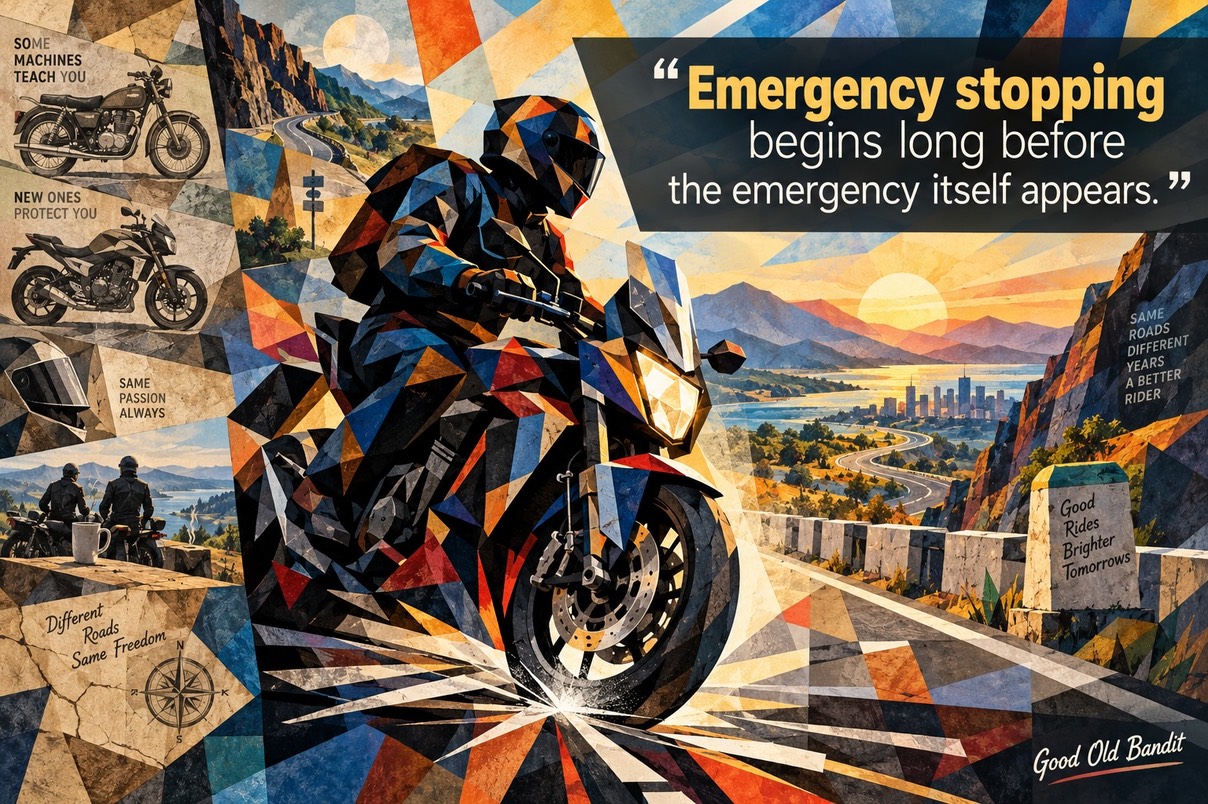
Good Old Bandit
Why Barber Belongs on Every Rider’s List
Walk through a century of motorcycles at Barber and see why every old machine still has something to teach a young rider.
I have spent more than forty years around motorcycles, and one thing still stops me in my tracks: an old bike that has clearly lived a life.
It might be the shape of a fuel tank, a worn seat, an engine built before anyone had heard of ride modes, or a set of pipes that look ready to shake a quiet street awake.
That is why the Barber Vintage Motorsports Museum in Birmingham, Alabama, fascinates me.
Guinness named Barber the world's largest motorcycle collection in 2014. Today, it holds more than 1,800 motorcycles covering over a century of production, with more than 1,000 displayed at a time and machines from hundreds of makers across 22 countries.
Those numbers are impressive.
But the numbers are not the reason I want young riders to know this place.
The real story is what those motorcycles say about us.
A Thousand Different Answers to the Same Question
Why have people kept building motorcycles for more than a century?
When you have ridden for decades, you stop seeing motorcycles as a neat line from old and slow to new and fast.
Every era was trying to solve its own problem.
Some builders wanted more speed. Others wanted less weight. Some wanted a motorcycle tough enough for poor roads. Some wanted beauty. Some wanted race wins. Others simply wanted to give ordinary people a cheap way to get somewhere.
Walk through Barber and those ideas sit beside one another in steel, paint and rubber.
You see names that still rule showrooms and others that vanished long ago. Harley-Davidson, Honda and Indian share history with makers many young riders may never have heard of.
That matters.
Motorcycling has never belonged to one brand, one nation or one type of rider.
That is part of what makes #MotorcycleHistory worth knowing.
Old Motorcycles Make You Look Twice
They remind us how much riders once had to do for themselves.
My early motorcycles did not protect me from poor choices.
There were no screens telling me which riding mode I was in. No electronic safety net waiting quietly behind my right wrist. You listened to the motor. You watched the road. You learned what the front tyre was saying through the bars.
Modern motorcycles are better in countless ways, and I have no wish to turn the clock back.
Yet old machines carry something worth keeping: honesty.
You can look at an early motorcycle and almost follow the builder's train of thought. Engine. Tank. Wheels. Frame. Controls. Nothing seems hidden.
That mechanical link between rider and machine helped teach generations of us respect.
A motorcycle does not need to scare you to earn respect. It needs you to pay attention.
That is still true in the age of #ModernMotorcycles.
Machines Carry Human Stories
The best motorcycle museums are really museums about people.
I have never believed a motorcycle becomes worthless when the engine stops.
Look at one long enough, and you begin asking questions.
Who designed it? Who raced it? Who saved for it? Who rode it home for the first time? Which road did it know best?
Barber understands that history has value beyond price. The museum even notes that part of a vintage motorcycle's value lies in the history attached to the machine.
Forty years of riding has taught me the same lesson.
I remember motorcycles not by their spec sheets, but by mornings.
Cold starts. Fuel stops. Rain arriving twenty miles too soon. Tea beside a road. Friends appearing in a mirror behind me. An engine ticking quietly as it cooled after a long ride.
That is #RiderLife.
The motorcycle becomes part of the memory because it took you there.
The Past Should Make Young Riders Curious
Motorcycle culture survives only when another generation chooses to ride.
If you are young and motorcycles interest you, do not assume you need to know everything before you begin.
None of us did.
Start with curiosity.
Learn why motorcycles were built the way they were. Listen to older riders, but do not copy every habit they had. Respect the past without becoming trapped in it. Ride modern machines. Use modern safety gear. Build skill slowly.
Most of all, understand what you are joining.
Motorcycling is more than speed.
It is craft, design, risk, discipline, travel, friendship and independence compressed into two wheels.
A place such as Barber proves how deep that story runs. Its collection spans more than 100 years of motorcycle design and engineering.
You are not merely buying a bike.
You are entering a story that began long before you.
Keep the Engines in the Story
Some machines belong in museums. The spirit behind them belongs on the road.
One day, I would like every young rider to stand in a place like Barber and look across row after row of motorcycles.
Not because old bikes were better.
They were not.
Go there because each one is proof that someone cared enough to try something.
Someone drew it. Built it. Raced it. Improved it. Broke it. Fixed it. Rode it.
And somewhere in that vast room, a young person may look at one machine and think, I want to know what riding feels like.
That thought matters.
Forty years from now, the motorcycles will have changed again.
The reason we ride may not.
The road keeps changing. The need to feel alive on it does not.
#GoodOldBandit #Motorcycles #MotorcycleLife #MotorcycleHistory #BarberVintageMotorsportsMuseum #VintageMotorcycles #RiderLife #MotorcycleCulture #YoungRiders #TwoWheels #RideWithRespect