Good Old Bandit
A Rider’s Walk Through Britain’s Motorcycle Past
Walk through Britain’s motorcycle past and see why old bikes still have something vital to teach the riders of tomorrow.
I have spent more than forty years around motorcycles, yet an old bike can still make me stop in my tracks.
It may be the shape of a fuel tank. The yellowed face of a speedometer. A cooling fin worn dark with age. Sometimes it is nothing more than an old badge on a petrol tank, yet it takes me straight back to days when motorcycles leaked a little oil, brakes needed respect, and every long ride felt like a small act of faith.
That is why Britain’s National Motorcycle Museum means more to me than a hall filled with machines.
Located in the West Midlands, it holds more than 1,000 British motorcycles from over 170 makers, with machines ranging from an 1898 pioneer bike to modern British superbikes. Around 850 are on show at any one time across five halls.
That is not just a collection.
It is a family album of motorcycling.
When Motorcycles Still Asked Something of You
Old machines show how much riding has changed — and how much has stayed the same.
My early motorcycles were nothing like the bikes young riders can buy today.
There were no riding modes watching over you. No bright TFT screen telling you what was happening. The machine spoke through vibration, sound, smell, and the movement of its controls.
You learned to listen.
Walk past an old BSA, Norton, Triumph or Royal Enfield and you begin to see where that world came from. The museum has large groups of machines from many of these old British names, letting visitors see how the motorcycle changed across the years.
Yet I never look at those bikes and think, Things were better then.
They were different.
Modern motorcycles are safer, faster, and far easier to live with. I admire that progress. What I hope we never lose is the bond between rider and machine.
A motorcycle should still ask for your attention.
That is part of #MotorcycleLife.
Every Old Motorcycle Was Once Someone’s New Bike
History becomes far more powerful when you remember that people actually rode these machines.
Museum bikes can look too perfect under bright lights.
I prefer to imagine them somewhere else.
A cold English morning. A rider pulling on thick gloves. Someone setting off for work on a machine that we now call a classic. A young man taking his first long trip. A woman learning to ride when motorcycling still sat well outside what society expected of her.
The museum opened in 1984 with 350 motorcycles. Its collection has since grown to more than 1,000 restored machines.
But motorcycles were never built to become exhibits.
They were built to move.
I have ridden through rain that seemed to come sideways. I have watched the sun drop behind empty roads while the engine settled into that steady rhythm every long-distance rider knows. I have stopped at roadside tea stalls simply because the motorcycle beneath me needed a rest — and perhaps I did too.
Those are the moments that turn metal into memory.
That is what #ClassicMotorcycles represent to me.
British Motorcycling Was Never Just One Famous Badge
The museum reveals a motorcycle world far wider than the names most riders know.
Young riders will know Triumph. Many will know Norton, BSA or Royal Enfield.
But start walking through British motorcycle history and the number of names can surprise you.
The museum represents more than 170 British marques, spanning pioneer, veteran, vintage and post-war eras. Its collection policy remains focused on motorcycles and material tied to the British motorcycle industry.
That matters because motorcycling grew through trial and error.
Someone tried a new frame.
Someone changed an engine.
Someone went racing.
Someone failed.
Someone else looked at that failure and built something better.
Young riders sometimes enter motorcycling through horsepower figures and top-speed videos. Nothing wrong with that. I loved fast motorcycles when I was young too.
But the longer you ride, the more interesting the story becomes.
You begin asking why motorcycles feel different. Why some brands survived. Why certain engines became icons. Why racing changed road bikes.
Curiosity makes you a richer rider.
#BritishMotorcycles can teach plenty if you are willing to look closely.
The Race Bikes Tell Another Story
Competition has always pushed motorcycles — and riders — beyond what seemed possible.
One of the museum halls is devoted to competition motorcycles, from road racers and off-road machines to sprint bikes and dragsters. It also houses machines such as the Norton connected with Steve Hislop’s famous 1992 Senior TT victory.
Race motorcycles have always fascinated me.
Not because I think every road rider needs to behave like a racer.
Quite the opposite.
Racing shows what happens when skill, nerve, engineering and control meet at the edge.
Years on the road teach you something similar. Speed alone is easy. Judgment takes years.
Knowing when to slow down is part of becoming quick.
Knowing when not to ride hard is part of becoming experienced.
That lesson matters far more than horsepower.
It is one reason #RideSafe should never sound dull. Real skill creates freedom.
The Next Chapter Is Waiting Outside
The best way to honor motorcycle history is not to stare at it forever.
If you are young and motorcycles interest you, spend time around old bikes.
Look at them.
Ask questions.
Talk to riders who have been doing this longer than you have been alive.
Then go and build your own story.
Do not ride because motorcycles look rebellious. Do not ride because someone online made the life seem glamorous.
Ride because you want to learn.
Motorcycling has given me roads I would never have taken, people I would never have met, and memories that still return whenever an engine fires nearby.
The National Motorcycle Museum preserves Britain’s motorcycle past.
Your job is not to copy that past.
Your job is to understand it, respect it, and then ride forward.
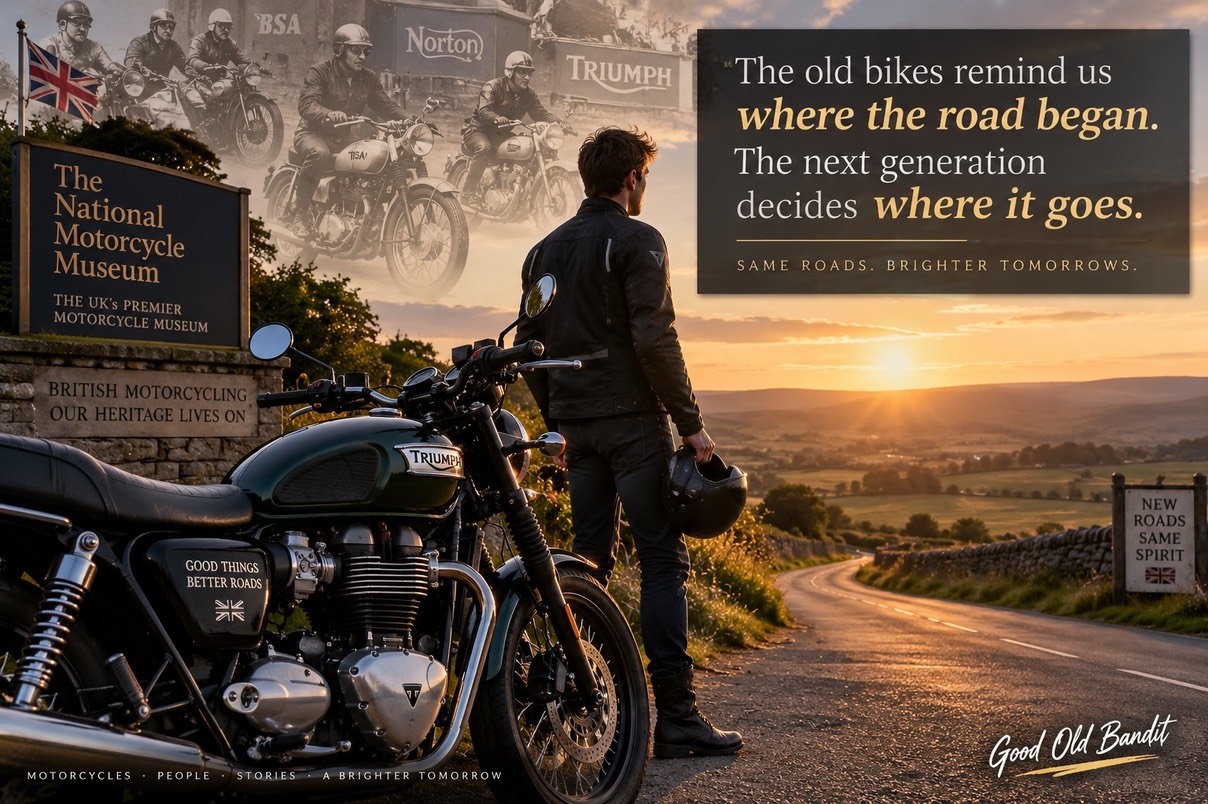
The old bikes remind us where the road began. The next generation decides where it goes.
#GoodOldBandit #Motorcycling #MotorcycleLife #ClassicMotorcycles #BritishMotorcycles #MotorcycleHistory #MotorcycleMuseum #YoungRiders #RideSafe #MotorcycleCulture #TwoWheels