Good Old Bandit
The Quiet Art of Carrying Control into a Corner
Trail braking is more than technique. It is about control, judgement, confidence, and becoming a smoother motorcycle rider.
Some riding skills arrive with noise, speed, and excitement. Trail braking arrives quietly. You feel it through your fingers, front tyre, and growing judgement. After four decades on motorcycles, I see it less as braking late and more as staying connected with the machine.
The Corner That Changes Your Thinking
Trail braking begins with judgement long before it becomes a braking technique.
I first understood cornering badly, which is often where useful lessons begin.
My early motorcycles had modest power, narrow tyres, and brakes requiring a firm conversation. There was no cornering ABS watching over me. Suspension adjustment usually meant checking whether anything had fallen loose.
Those machines still taught lessons that remain valuable on today's motorcycles.
One evening, I entered a tightening bend carrying more speed than good sense allowed. The road looked harmless from the approach, then disappeared sharply behind scrub and broken tarmac.
My instinct told me to finish braking before leaning the motorcycle.
That was the advice many riders heard repeatedly during those years. Brake upright, release everything, turn the motorcycle, then accelerate away once the road opened.
It works remarkably well when every corner behaves exactly as expected.
Real roads rarely offer that courtesy.
I released the front brake, leaned over, and immediately realised the corner kept tightening. My choices suddenly felt much smaller than they had three seconds earlier.
I survived the bend without drama, but the experience stayed with me.
The lesson was not that I needed greater courage.
I needed more options.
That remains the heart of trail braking for me today. It gives a rider another measured tool when entering corners on unpredictable roads.
Trail braking means carrying a controlled amount of braking pressure into the turn. As lean angle increases, braking pressure gradually reduces until the rider releases the brake.
The words make the technique sound almost mechanical.
On the motorcycle, it feels more like maintaining a conversation.
You remain connected to speed, steering, suspension, grip, and the changing radius ahead.
That connection matters far more than arriving at the corner heroically late.
Braking Does Not End at the Turn-In Point
The front brake can remain part of corner entry without becoming an enemy.
Young riders sometimes speak about braking and cornering like separate chapters.
Four decades on motorcycles have taught me they often overlap naturally.
When you apply the front brake, weight transfers toward the front tyre. The forks compress, and the motorcycle's geometry changes slightly.
That loaded front tyre can provide reassuring steering feel during corner entry.
Gradually reducing brake pressure lets those forces unwind smoothly.
The important word is gradually.
Trail braking never means grabbing the lever while deeply leaned over.
That kind of abrupt input can overwhelm available tyre grip very quickly.
A motorcycle tyre has a limited grip budget.
Ask heavily for braking while asking heavily for cornering, and trouble arrives quickly.
Good trail braking respects that relationship.
As lean angle increases, braking pressure decreases.
I think of those two forces almost like riders passing each other on a narrow road. One gives away space as the other takes more of it.
Years ago, I rode an old hill road after several days of rain. Moss sat near the edges, and loose gravel appeared without warning.
I was riding a heavy motorcycle that disliked sudden decisions.
Through those bends, light braking pressure gave me something valuable: time.
I could enter calmly, watch the road develop, then release the brake as confidence increased.
Nothing about that ride was fast.
Everything about it felt satisfying.
That distinction matters.
Motorcycling creates joy long before the speedometer begins telling impressive stories.
#TrailBraking should ultimately create composure, not bravado.
Speed Is Only Half the Story
The real value lies in controlling uncertainty before the corner reveals everything.
Many riders first hear about trail braking through racing.
They watch racers brake impossibly late, carry pressure toward the apex, then launch forward.
That creates an understandable misunderstanding.
Street trail braking is not simply racing technique transported onto public roads.
A racetrack offers repeated corners, known surfaces, marshals, runoff areas, and controlled traffic.
A mountain road may offer diesel, livestock, potholes, buses, stones, or stopped vehicles.
I have encountered nearly every one of those surprises.
Once, on a long ride through winding countryside, I entered a blind left-hander at moderate speed. A tractor stood almost completely across my lane beyond the bend.
I was already carrying slight front brake pressure.
That small detail changed everything.
My fingers were prepared. The front suspension was already settled under load. My speed was already moving downward rather than upward.
I increased braking progressively while standing the motorcycle slightly more upright.
The moment lasted seconds.
The memory lasted years.
Trail braking had not made me faster.
It had made the situation less sudden.
That is the part younger riders should remember.
Motorcycle control is often about reducing surprises before they become emergencies.
#MotorcycleSafety does not need to remove excitement from riding.
Good technique creates space for enjoyment because fewer situations become desperate.
The Fingers Become Part of the Suspension
Smooth pressure matters more than strength, aggression, or dramatic braking.
Older motorcycles developed your fingers whether you wanted training or not.
Some brake levers needed considerable pressure before anything meaningful happened. Others offered vague feedback until the final portion of their travel.
Modern motorcycle brakes can feel almost supernatural beside those systems.
A gentle squeeze on a good radial master cylinder can produce serious stopping force.
That makes sensitivity even more important.
I usually think about trail braking through two fingers and one intention.
The intention is smoothness.
Initial braking happens while the motorcycle remains upright. The rider sheds most speed before reaching the turn.
As the bike begins leaning, the lever pressure begins fading.
The release matters just as much as the application.
Dump the brake suddenly, and the forks can extend quickly.
The motorcycle's balance changes when you least want unnecessary movement.
Release progressively, and the chassis settles naturally into the corner.
That smooth transition is one reason experienced riders can appear almost slow from behind.
Their motorcycles move less.
Their bodies move less.
Their corrections remain smaller.
Years ago, I followed an older rider through a series of mountain bends. His motorcycle carried luggage and certainly possessed no performance advantage.
I expected to catch him easily.
I never did.
He barely seemed to brake, yet he never entered a bend hurriedly.
At a tea stop, I asked about his cornering.
He smiled and said, “I finish every corner before I start fighting it.”
That sentence stayed with me.
Good trail braking should feel like removing conflict from the motorcycle.
The machine should never feel surprised by your hands.
Reading the Road Still Comes First
Technique becomes valuable only when judgement decides where it belongs.
No braking technique can replace looking far enough ahead.
The greatest improvement in my riding came from seeing more, not doing more.
Look through the corner whenever visibility allows.
Watch the road surface.
Notice changes in camber.
Read tree lines, poles, barriers, shadows, and traffic movement.
The landscape often tells you where the road travels before the tarmac becomes visible.
Some forgotten backroads taught me that better than any formal session could.
A narrow road through forest country once gave me thirty kilometres of unpredictable bends. Some corners opened beautifully, while others tightened beside drainage cuts.
I stopped chasing an imagined perfect line.
Instead, I began leaving myself margin.
Trail braking became useful because I could delay committing fully to speed and direction.
That does not mean crawling into every corner while squeezing the lever.
It means remaining flexible during the uncertain part of corner entry.
Once visibility improves and the corner begins opening, the brake leaves completely.
The motorcycle settles toward the desired line.
Then throttle can return smoothly.
That rhythm feels almost musical when everything connects.
Brake.
Turn.
Release.
Settle.
Drive.
After enough miles, these actions begin overlapping without feeling hurried.
#MotorcycleRiding becomes deeply rewarding when technique disappears beneath awareness.
Fear Can Become Useful Information
Confidence grows when riders understand their reactions instead of hiding them.
Every rider eventually scares himself.
Anyone claiming otherwise has either forgotten something or ridden very little.
Fear itself is not the problem.
Panic creates the danger.
I once misjudged a descending bend during a long mountain ride. Gravity added more speed than expected, and the road tightened halfway through.
For a fraction of a second, every old instinct shouted at once.
Stand the bike up.
Grab the brakes.
Look toward the edge.
Those reactions feed one another.
Instead, I kept my eyes toward the exit and added gentle front brake pressure. I reduced speed while maintaining a manageable lean angle.
The motorcycle followed my attention instead of my fear.
That moment changed my understanding of confidence.
Confidence does not mean believing nothing will go wrong.
Confidence means possessing enough calm to respond when something does.
Trail braking can build that calm when practiced responsibly.
The rider knows speed can still be adjusted during early corner entry.
That knowledge removes the feeling of being committed helplessly toward whatever comes next.
Still, respect must remain.
Too much brake pressure with excessive lean can exceed available traction.
Poor road surfaces reduce that margin further.
Cold tyres, rain, gravel, painted lines, and diesel demand even greater restraint.
Motorcycling rewards confidence only while confidence continues listening.
Modern Motorcycles Still Need Human Judgement
Electronics create remarkable support, but the rider remains responsible for every decision.
I admire modern motorcycles enormously.
Some riders from my generation enjoy pretending everything new has made motorcycling worse.
I disagree.
Modern tyres offer extraordinary grip.
ABS has saved countless mistakes.
Cornering ABS, traction control, riding modes, and sophisticated suspension provide remarkable support.
I would have welcomed many of those systems during my younger years.
Still, electronics cannot read intention.
They cannot see the badly repaired patch of road before the apex.
They cannot decide whether entering five kilometres per hour slower creates better visibility.
They cannot tell when fatigue has started damaging judgement.
Riders make those decisions.
The motorcycle helps execute them.
That partnership remains beautiful.
A modern motorcycle may have an inertial measurement unit calculating lean and acceleration constantly. Yet the rider's fingertips still decide whether pressure arrives smoothly or suddenly.
Technology changes.
Good judgement remains stubbornly old-fashioned.
That is one reason motorcycling still matters in an increasingly automated world.
You participate fully.
Your eyes, hands, feet, balance, judgement, and emotions remain involved.
The machine demands presence.
For younger people surrounded by screens and endless digital noise, that presence carries enormous value.
On a motorcycle, the next corner deserves your entire attention.
Few things in modern life ask for that honestly.
The Quiet Pleasure of Getting It Right
Great cornering rarely feels dramatic from the rider's seat.
Some of my happiest motorcycle memories contain almost nothing worth posting online.
There was no enormous jump.
No knee touched the road.
Nobody recorded anything.
One morning, I rode before sunrise on roads still empty from the night. The air felt cool, and the motorcycle had finally settled into its familiar rhythm.
I entered one long sweeping bend with gentle brake pressure.
The front tyre felt planted.
I eased the pressure away as the corner opened.
Throttle returned smoothly, and the motorcycle flowed toward the next straight.
That was all.
Yet I remember that corner decades later.
Everything simply worked.
Those moments explain motorcycling better than spectacle ever could.
You begin riding because motorcycles look exciting.
You continue because they slowly reveal depth.
Every skill contains another layer.
Every familiar road feels different in changing weather, light, traffic, tyres, or mood.
Trail braking becomes part of that deeper relationship.
At first, you think about the lever.
Later, you think about balance.
Eventually, you think about the whole corner.
The technique becomes almost invisible.
That is when riding starts feeling wonderfully simple again.
#RideSmooth becomes more meaningful with every passing year.
A Skill That Rewards Patience
Real progress appears through smoother decisions rather than bigger risks.
Trail braking should never become another trick riders rush to display.
Motorcycles punish rushed confidence.
Start understanding the sensation at sensible speeds and in generous conditions.
Feel the front suspension compress during braking.
Notice the motorcycle's response when pressure reduces smoothly.
Pay attention to steering feel as load changes.
An empty, familiar road can reveal more than an aggressive mountain chase ever will.
A closed riding facility offers an even better environment for experimenting safely.
The goal is not reaching greater lean while keeping greater brake pressure.
The goal is understanding what the motorcycle communicates during transitions.
Young riders sometimes believe advanced riding means doing dramatic things.
Much of advanced riding involves avoiding drama entirely.
That truth becomes clearer with age.
Smooth riders usually create fewer emergencies because they recognize trouble earlier.
They carry more mental space into every decision.
Trail braking belongs inside that philosophy.
It should make the ride calmer.
It should make the motorcycle feel more settled.
It should give the rider options without encouraging unnecessary speed.
That is mastery worth pursuing.
Forty Years Later, the Corner Still Matters
Motorcycling stays alive because every ride continues asking something from us.
After more than forty years around motorcycles, I still approach certain corners with curiosity.
Machines have changed beyond anything my younger self could have imagined.
Roads have changed too.
Some became wide highways.
Others vanished beneath development.
A few wonderful backroads remain almost exactly as I remember them.
I have ridden motorcycles that vibrated bolts loose before lunch.
I have ridden modern machines that feel carved from engineering precision.
Each one carried something worth remembering.
Trail braking sits among countless small lessons accumulated across those miles.
It taught me that control does not come from rigidity.
Control comes from remaining adaptable.
It taught me that slowing down and moving forward are not opposites.
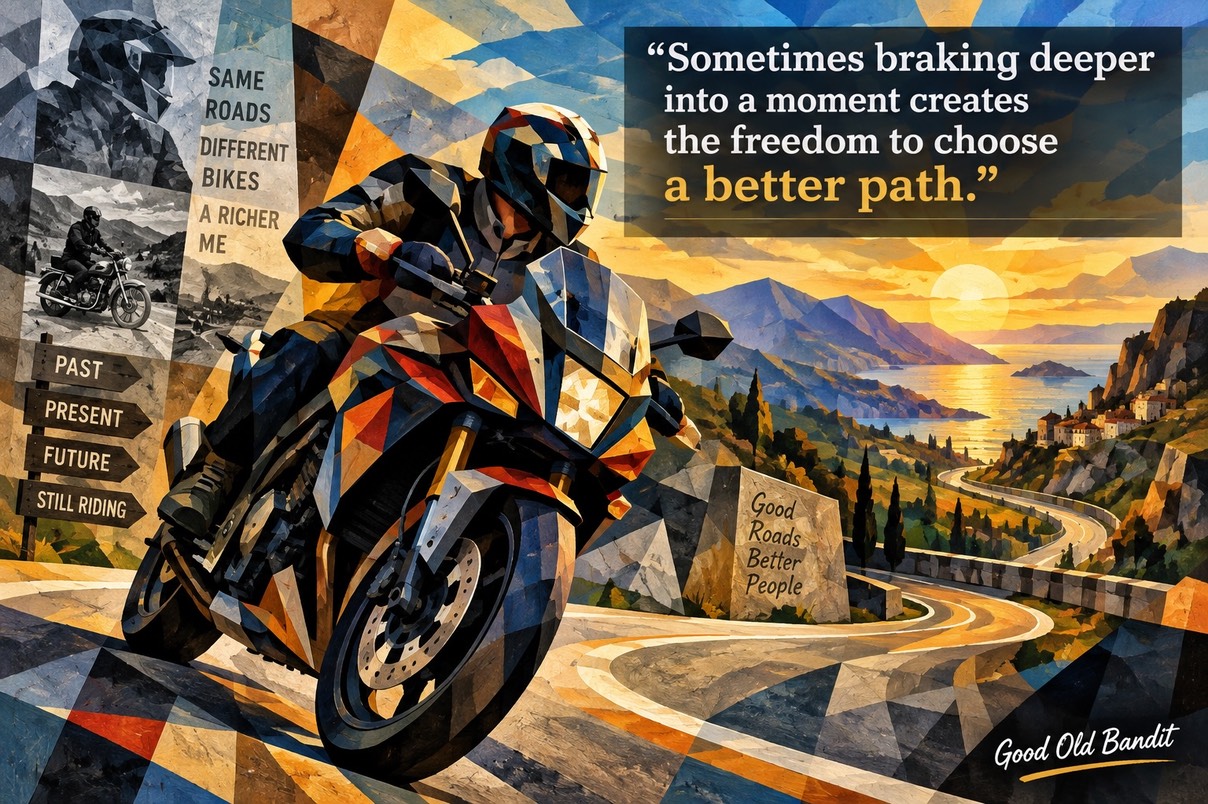
Sometimes braking deeper into a moment creates the freedom to choose a better path.
That lesson reaches beyond motorcycles, although motorcycles taught it beautifully.
I hope young riders enter this world.
I hope they respect the machine without fearing it.
I hope they chase competence before applause.
Most of all, I hope they experience that extraordinary moment when rider, motorcycle, road, and attention suddenly become one continuous movement.
You do not need forty years to feel it.
Sometimes one good corner is enough.
Carry Something into the Next Corner
Motorcycling has never been only about reaching somewhere.
The road teaches patience, awareness, humility, courage, and restraint.
Trail braking carries those qualities inside one small movement of the fingers.
You approach uncertainty while keeping control available.
You commit progressively rather than blindly.
You respect grip instead of demanding obedience from it.
And when the road finally opens, you release the brake and move forward.
After all these years, that still feels like freedom to me.
The motorcycle keeps giving back when we keep paying attention.
Ride long enough, and every corner leaves something behind.
Ride thoughtfully, and you carry something valuable into the next one.