Good Old Bandit
Emergency braking is more than technique. It is calm, control, instinct, and the experience that keeps a rider moving forward.
Forty years of riding teaches you something strange about motorcycles. The finest moments are rarely about speed. Sometimes, they are about stopping. A child crossing a road, gravel after a bend, or traffic freezing ahead can change everything. In those seconds, your motorcycle reveals your habits, and you discover the rider you have become.
The Moment the Road Changes
Every long riding life contains a few seconds that never completely leave you.
My earliest motorcycles were simple machines with equally simple expectations. They started, they rattled, and they demanded your full attention.
There were no electronic riding modes watching over your shoulder. Brakes required respect, tyres had limits, and roads offered regular surprises.
I remember one afternoon from those early years very clearly. I was travelling along a narrow road outside town after light rain.
The surface looked harmless, though patches of mud sat quietly near the edges. A bus suddenly stopped ahead without much warning.
I remember my fingers closing around the brake lever. I also remember the motorcycle becoming very light beneath me.
Nothing dramatic happened, which remains the important part of that memory. I stopped with enough road left and continued riding.
Yet those few seconds stayed with me for decades. They taught me something speed never could.
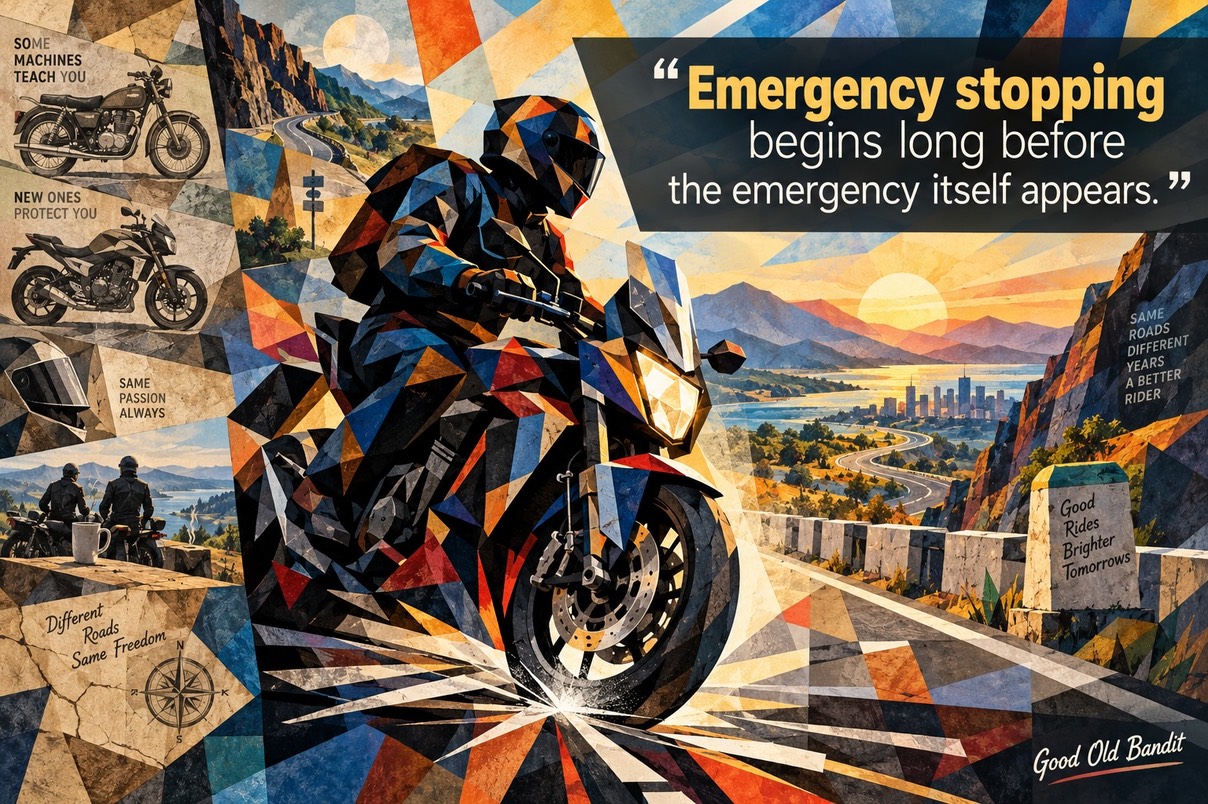
Emergency stopping begins long before the emergency itself appears.
It develops through every ordinary junction, every wet road, and every controlled stop made without thinking much about it.
That is one of motorcycling's great truths. Your everyday habits become your emergency reactions.
Young riders often admire cornering photographs and acceleration figures. I understand that completely because I once did the same.
Yet braking confidence creates a different kind of freedom. You ride knowing the motorcycle can lose speed as confidently as it gains speed.
That confidence is part of real #MotorcycleSafety, though it never needs to feel dull.
It can make riding more enjoyable.
Your Hands Remember Before Your Mind Does
Good braking becomes instinct only after calm repetition has made it familiar.
A genuine emergency rarely sends an invitation beforehand. Something changes, and suddenly the available road becomes painfully short.
Your first reaction matters because panic loves abrupt movements. Motorcycles usually respond better to firm, progressive actions.
Through the years, I have watched riders grab the front brake suddenly. I have also seen riders almost ignore it completely.
Both reactions usually come from fear rather than understanding.
The front brake carries much of the stopping work as weight transfers forward. The rear brake adds stability and useful braking force.
Modern ABS has made those difficult moments much more forgiving. I welcome that development without hesitation.
Some older riders speak about electronics as though hardship created better motorcyclists. I have never believed that.
A safer motorcycle gives a rider more room to develop. Skill and technology should support each other.
Even with ABS, the rider's input still matters greatly. A smooth, strong squeeze allows the tyre and suspension to settle.
I once rode an older Japanese machine through a mountain road before sunrise. It had good brakes for its era.
A dog appeared from behind a parked truck near a village. There was almost no warning.
My fingers tightened progressively rather than snatching the lever. My foot pressed the rear brake at nearly the same moment.
The motorcycle settled hard onto its front suspension. The dog disappeared across the road, completely unaware of my pounding heartbeat.
I stopped, breathed, and looked at the empty lane ahead.
That motorcycle had no clever electronics saving the situation. What helped was repetition developed over many quieter stops.
Today, ABS provides another valuable safety layer. The basic relationship between rider and machine remains.
Your hands need familiarity before fear arrives.
That is #RideSafe in its most practical form.
The Front Wheel Tells the Truth
Grip changes constantly, and experienced riders never assume yesterday's road exists today.
Tyres give motorcycles their astonishing ability to accelerate, corner, and stop. They perform everything through remarkably small contact patches.
That fact has kept me humble for decades.
A dry highway can offer tremendous braking grip. The same road becomes another place after rain, sand, diesel, or loose gravel.
I remember crossing Rajasthan years ago during a long summer ride. The highway stretched ahead under brutal afternoon heat.
A tractor joined the road unexpectedly from a dusty track. Fine sand had gathered where both surfaces met.
I had enough distance, but the lesson remained sharp. Road surface matters as much as braking strength.
When the motorcycle is upright, braking forces work more cleanly through the tyres. During cornering, grip already carries another responsibility.
That changes everything.
If danger appears while leaned over, reducing lean becomes valuable whenever space permits. A straighter motorcycle can devote more grip toward stopping.
That principle sounds almost too simple. On the road, it becomes one of those ideas worth carrying forever.
The machine constantly communicates through the bars, suspension, tyres, and seat. Riders gradually become better listeners.
This listening is one reason motorcycling remains fascinating after four decades. There is always another layer to understand.
I have ridden motorcycles far faster than my first machine. I have ridden machines with sophisticated suspension and excellent ABS.
Yet a patch of gravel still deserves respect.
Experience does not remove risk. It improves your relationship with it.
Panic Is Fast, Calm Is Faster
The strongest emergency response comes from control rather than aggression.
People often imagine an emergency stop as a violent act. In reality, the best ones can feel surprisingly controlled.
You see danger, close the throttle, apply both brakes, and keep your attention ahead.
The front suspension compresses as weight moves forward. The motorcycle sheds speed with an urgency you rarely request during normal riding.
The clutch also becomes relevant as the motorcycle slows sharply. Pulling it prevents the engine from fighting the final part of the stop.
Yet none of these movements should feel like separate commands. With practice, they become one coordinated response.
Years ago, another rider and I were returning home after a long day. Evening traffic had started building near the city.
A car cut across two lanes toward an exit. The rider ahead of me stopped quickly and cleanly.
I remember watching his shoulders afterward. They remained loose rather than locked with panic.
That image stayed with me.
A tense rider often makes tense control inputs. A relaxed rider gives the motorcycle space to work.
Nobody remains perfectly calm during every surprise. Forty years on motorcycles does not turn anyone into stone.
Your heart can still jump. Your mouth can still go dry.
The aim is not eliminating fear. The aim is giving fear less authority over your hands.
That distinction matters.
#EmergencyBraking is partly mechanical, but it is also emotional control measured in fractions of a second.
Your Eyes Decide More Than You Think
Where you direct attention can shape the entire outcome.
Motorcycles have a strange way of following attention. Riders understand this quickly through cornering.
The same principle becomes important during a sudden stop.
There is a powerful temptation to stare directly at the hazard. The car, animal, barrier, or fallen object becomes everything.
That fixation can shrink your world when you most need options.
Keep seeing the road beyond the immediate problem. Notice available space, changing traffic, and possible escape paths.
Sometimes stopping completely remains the best answer. Sometimes reducing enough speed creates another safe option.
The road rarely presents identical emergencies twice.
I once encountered fallen branches after a blind bend during a countryside ride. Hard braking removed most of my speed immediately.
The remaining space allowed me to pass through a clear section. I would never have seen it while staring at the largest branch.
That moment changed something in my riding.
A motorcycle rider should respect danger without becoming hypnotised by it.
Your eyes remain active even while the brakes work hard.
This awareness sits at the heart of defensive riding. It also makes ordinary riding richer.
You begin noticing surfaces, shadows, intersections, animals, mirrors, and the body language of other road users.
The road starts speaking earlier.
That kind of awareness does not remove enjoyment. It creates more of it.
Confidence feels better when it comes from attention rather than luck.
Modern Motorcycles Deserve Modern Respect
Technology has changed enormously, while responsibility still sits in the saddle.
The motorcycles available today would have looked astonishing during my early riding years.
Tyres grip better, frames are stronger, brakes are sharper, and ABS has become increasingly common.
Some motorcycles can even adjust braking behaviour through sophisticated electronic systems.
I admire these machines.
I also admire the old motorcycles that taught riders mechanical sympathy. Their limitations forced you to understand what was happening beneath you.
The best approach takes something from both eras.
Respect the machine as an old rider would. Use modern safety technology without apologising for it.
ABS deserves special appreciation during emergency braking. It can prevent wheel lock when braking pressure exceeds available grip.
That can make a huge difference during panic situations. It remains one of motorcycling's most valuable modern advances.
Yet electronics cannot repair poor observation or impossible following distances. Technology buys opportunity, not invincibility.
I tell younger riders something simple whenever this subject appears.
Give yourself road.
Space ahead is perhaps the cheapest safety equipment ever fitted to a motorcycle.
It costs nothing, weighs nothing, and works with every brand.
It also gives your brakes the one thing they need most: time.
#MotorcycleLife becomes much richer when every ride does not become a contest for the smallest available gap.
Practice Changes the Meaning of Fear
Confidence grows when the motorcycle's reactions stop feeling mysterious.
There is tremendous value in experiencing firm braking before an emergency requires it.
A safe, controlled environment allows a rider to understand weight transfer and braking force without roadside pressure.
You begin gently, then build braking effort progressively as confidence grows. The motorcycle stops much harder than many beginners expect.
That realisation can transform your relationship with the machine.
I still remember the first motorcycle that made me appreciate genuinely powerful brakes. The stopping performance almost felt unnatural at first.
Years spent compensating for weaker equipment had shaped my expectations. The newer machine needed fewer compromises.
A few deliberate practice sessions changed everything.
The brakes stopped feeling fierce and started feeling precise.
This is where younger riders have an advantage my generation rarely enjoyed. Better motorcycles and better training opportunities now exist.
Use them.
Motorcycling rewards curiosity more generously than ego.
There will always be somebody faster. There will always be someone with a bigger motorcycle.
Those things matter far less after enough years on the road.
Control begins to feel more satisfying than display.
A clean emergency stop might never earn applause. It might never become a photograph or social media clip.
It may simply allow you to continue your journey.
That is enough.
Every Safe Stop Protects Another Ride
The real purpose of riding skill is returning to the road again tomorrow.
Motorcycling has given me some extraordinary memories.
I remember empty highways before sunrise and tea beside small roadside stalls. I remember mountain air entering an open visor.
I remember machines that leaked oil but somehow always reached home. I remember strangers becoming friends beside broken motorcycles.
I also remember frightening seconds.
Those memories belong together because motorcycling has never been only about pleasure. It asks something from us in return.
Attention.
Respect.
Humility.
A safe emergency stop represents all three.
You respect the road enough to expect surprises. You respect your motorcycle enough to understand its braking ability.
Most importantly, you respect yourself enough to build the reactions that protect your future rides.
That does not make motorcycling fearful.
For me, it does exactly the opposite.
Skill removes some uncertainty. Awareness makes the machine feel more connected rather than more dangerous.
Eventually, you begin riding with a quiet confidence that cannot come from horsepower figures.
You know when to accelerate. You know when to wait.
And when the world suddenly closes the road ahead, you know your motorcycle can stop.
The Road Still Calls
After more than forty years, motorcycles still excite me before a ride.
That feeling has never disappeared.
Machines changed. Roads became busier. Helmets improved, tyres improved, and braking technology changed beyond recognition.
Yet the attraction remains wonderfully simple.
You sit on a motorcycle, start the engine, and the world suddenly feels closer.
A safe emergency stop belongs to that same experience. It is not separate from the joy of riding.
It protects the joy.
Every rider hopes never to need maximum braking unexpectedly. Every serious rider should respect that moment before it arrives.
Become comfortable with your motorcycle. Understand its brakes, tyres, weight, and reactions.
Give yourself space. Keep your eyes alive. Let smooth control overcome panic.
Then keep riding.
There are still mountain roads waiting beyond ordinary mornings. There are still friendships waiting beside unfamiliar motorcycles.
There are still small cafés, forgotten trails, coastal highways, and roads without famous names.
Motorcycling has always rewarded those willing to pay attention.
Ride with enthusiasm. Ride with curiosity.
And carry enough control to make sure the next road remains yours.
#MotorcycleSafety #EmergencyBraking #RideSafe #MotorcycleLife #MotorcycleRiders #MotorcycleJourney #DefensiveRiding #MotorcycleControl #SafeRiding #GoodOldBandit