
Good Old Bandit
Forty Years of Finding Control on Two Wheels
Four decades of riding reveal a simple truth: real motorcycle control begins with the rider’s body, balance, trust, and feel.
A motorcycle remembers every careless input your body makes. It also rewards every moment when rider and machine finally agree. After forty years on two wheels, I believe body positioning is less about technique than conversation. Your motorcycle speaks through its bars, tyres, suspension, and seat. The best rides begin when you stop shouting back.
The First Time the Motorcycle Felt Alive
Control begins when a machine stops feeling like an object beneath you
My earliest motorcycles never had riding modes, traction control, or colorful screens. Some barely had dependable electrics.
What they offered was something far more valuable. They made every mistake painfully clear.
I still remember an early morning ride on a small two-stroke many decades ago. The road was narrow, patched, and empty except for the occasional bus. I entered one bend carrying more enthusiasm than judgement.
My shoulders tightened before the corner even arrived. My arms followed, then my hands squeezed the bars harder. Suddenly, the motorcycle seemed unwilling to turn.
At that age, I blamed the motorcycle.
Older riders will smile at that sentence.
Years later, I understood what happened. The motorcycle had not become difficult. I had become difficult.
My entire upper body was fighting an otherwise willing machine.
That lesson has followed me across highways, mountain roads, gravel tracks, and city traffic. Motorcycles respond strongly to the person sitting upon them.
Body positioning for motorcycle control begins there.
A stiff rider can make a wonderful motorcycle feel nervous. A relaxed rider can bring remarkable calm to an ordinary machine.
The difference becomes obvious once enough kilometers pass beneath your wheels.
Motorcycling gradually teaches you that strength matters less than sensitivity. The motorcycle rarely needs wrestling when everything underneath you work correctly.
It wants clear inputs.
More importantly, it wants a rider who can feel what happens after making them.
That relationship still fascinates me after four decades.
The Day I Stopped Fighting Corners
A relaxed body creates space for the motorcycle to finish its work
There was a mountain road years ago that changed my understanding of cornering forever.
It climbed through forest before opening into long, sweeping bends. The surface changed constantly between smooth tar, broken edges, and damp patches.
I was riding with another motorcyclist who seemed almost annoyingly effortless.
He was not dramatically faster.
He simply looked calm.
His motorcycle leaned beneath him without the little corrections I kept making. His shoulders remained loose while mine carried unnecessary tension.
At a tea stop, we spoke about the road.
He never offered a lecture. He simply mentioned that I looked busy on the motorcycle.
That sentence stayed with me.
On the next stretch, I stopped trying to control every movement. I allowed my knees, hips, shoulders, and head to move more naturally.
Something changed immediately.
The motorcycle stopped feeling reluctant.
Corners opened instead of closing around me. Steering inputs became smaller, and my vision travelled farther ahead.
The motorcycle had been capable all morning. I had finally stopped interfering with it.
That remains one of my strongest memories about proper motorcycle body position.
People often picture body positioning as dramatic racetrack movement. Real roads usually ask for something quieter.
They ask for balance.
They ask for relaxed arms and an upper body capable of moving freely. They ask your head to remain connected with the road ahead.
Your body should support motorcycle control rather than interrupt it.
That sounds simple because it is simple.
Simple does not mean easy.
A Motorcycle Feels Your Fear Before Anyone Else Does
Tension travels directly from the rider into the machine
Every long-term rider eventually meets fear.
Anyone claiming otherwise probably has a selective memory.
I once crossed a stretch of road during heavy rain with visibility disappearing rapidly. Trucks threw sheets of water across my visor, while standing water appeared without warning.
The motorcycle underneath me was perfectly healthy.
My confidence was not.
My hands slowly began tightening around the grips.
Then my shoulders rose.
Then every small movement from the front tyre felt enormous.
Fear had changed my body positioning before anything dangerous actually happened.
That distinction matters.
A frightened rider often becomes rigid. A rigid rider reduces the motorcycle’s freedom to move underneath them.
Modern motorcycles hide some of this beautifully. Their chassis, suspension, tyres, electronics, and brakes can compensate for remarkable amounts of clumsiness.
Yet physics remains remarkably old-fashioned.
Your motorcycle still responds to weight, pressure, movement, and tension.
I eventually eased my grip during that rainstorm. I stopped treating every movement beneath me as a warning.
The machine settled.
More importantly, I settled.
We reached a roadside shelter several kilometres later, soaked despite our waterproof clothing. Another rider arrived soon afterwards on an old Bullet.
We drank terrible tea from tiny paper cups.
Nobody spoke about courage.
There was nothing heroic about that morning.
We had simply respected the conditions and kept ourselves composed.
Those experiences shaped my understanding of riding more than any perfect sunny road.
Motorcycle confidence is not the absence of fear.
It is the ability to stay connected with the machine when fear appears.
That connection begins physically.
Your breathing changes your shoulders. Your shoulders influence your arms. Your arms influence the bars.
Everything travels somewhere.
The motorcycle notices.
Old Machines Demanded Attention
Earlier motorcycles revealed every unnecessary movement a rider made
I have enormous affection for older motorcycles.
I also remember their faults clearly enough to avoid pretending everything was better then.
Brakes could be optimistic. Tyres offered surprises. Frames occasionally felt more philosophical than structural.
Yet those motorcycles had tremendous honesty.
A badly positioned rider could feel the consequences almost immediately.
Ride stiffly across broken roads and the handlebars reminded you. Carry your weight awkwardly through a bend and the chassis answered.
Sit carelessly during hard braking and everything seemed to arrive through your wrists.
Old motorcycles demanded participation.
I remember riding a powerful machine from that era for the first time. Its engine seemed far more talented than its brakes or suspension.
The throttle opened with real authority.
Every corner then required respect.
That motorcycle taught me something important about body positioning. Your position affects more than cornering style.
It affects braking stability, steering effort, fatigue, visibility, and confidence.
When my lower body supported me properly, my hands became calmer.
When my torso stayed balanced, braking became less dramatic.
When my head stayed upright, and eyes travelled forward, the motorcycle felt smaller beneath me.
These connections became instinctive slowly.
Nobody becomes an accomplished rider during one memorable Sunday.
Thousands of ordinary kilometers shape good motorcyclists.
Traffic shapes them.
Rain shapes them.
Bad roads shape them.
Long evenings returning home shape them.
That is part of the beauty behind #MotorcycleLife. The motorcycle keeps revealing something about your habits.
Sometimes the revelation is flattering.
Often it is not.
Modern Motorcycles Changed Everything Except the Rider
Electronics advanced rapidly, while balance and body awareness remained timeless
Today’s motorcycles are extraordinary.
Even modest machines now offer braking, tyres, suspension, and engine performance once reserved for expensive motorcycles.
I respect that progress enormously.
I have no desire to return to weak headlights merely because they looked charming.
Yet modern technology creates an interesting illusion.
A capable motorcycle can make poor habits invisible for surprisingly long periods.
Cornering ABS can protect a rider from certain mistakes. Traction systems can soften careless throttle inputs.
Modern tyres offer levels of grip that would have seemed magical forty years ago.
None of this makes body awareness less important.
It makes good body positioning even more rewarding.
Modern motorcycles respond beautifully when the rider works with their design.
The difference appears during long rides.
A rider who constantly grips the motorcycle through the arms becomes tired quickly. Every braking zone places more strain through wrists and shoulders.
A balanced rider spreads the work through the entire body.
The motorcycle also feels lighter.
I remember riding a modern machine through a series of fast open bends after years aboard older motorcycles. The precision felt almost unbelievable.
Yet the greatest pleasure came from something familiar.
My body still mattered.
A slight shift through the torso changed the motorcycle’s attitude. Relaxed elbows allowed subtle steering corrections without disturbing the chassis.
Looking through the bend remained as important as ever.
Forty years of engineering progress had not removed the rider from the equation.
That makes me happy.
Motorcycling still demands presence.
The Road Beneath Your Feet Changes the Conversation
Broken roads and forgotten trails reveal another side of rider balance
Some of my favorite riding memories have happened far away from perfect tarmac.
There is a different honesty about a rough road.
Loose stones, sand, broken surfaces, mud, and deep ruts remove unnecessary confidence very quickly.
Years ago, I followed a narrow track that looked harmless from the main road. Within twenty minutes, it had become a badly broken trail.
Turning back seemed sensible.
Naturally, I continued.
The motorcycle moved underneath me far more than expected. At first, every slide triggered an immediate reaction from my arms.
The more I fought those movements, the worse everything became.
Eventually fatigue forced me to loosen up.
That helped.
The motorcycle began finding its own path through smaller disturbances. My legs absorbed movement that my arms had previously tried to control.
I stopped expecting the bike to remain perfectly still.
That was the real breakthrough.
Motorcycle balance does not always mean keeping the machine motionless beneath you.
Sometimes control means allowing movement.
That idea carries beautifully from dirt into road riding.
A motorcycle needs room to breathe over bumps, cambers, painted lines, gravel, and uneven surfaces.
Young riders sometimes expect perfection from themselves too quickly.
They watch polished videos where every corner looks clean. Every movement appears deliberate and confident.
Real riding is messier.
You occasionally enter a corner awkwardly.
You misjudge a road surface.
You take the wrong line.
You get tired.
You have days when the motorcycle simply does not feel right beneath you.
Those moments matter because riding develops through them.
#RideMore should never mean chasing speed or proving courage.
It should mean gathering experience patiently.
Your Eyes Pull the Rest of You Along
Good body positioning starts long before the motorcycle reaches the corner
One thing has remained true across every motorcycle I have ridden.
The body usually follows the eyes.
A rider staring close to the front wheel often becomes physically cramped. Everything happens late because the road seems to arrive suddenly.
A rider looking farther ahead tends to open naturally.
The head turns.
The shoulders follow.
The torso becomes prepared for the road rather than surprised by it.
I experienced this strongly during a long solitary ride many years ago.
The highway eventually narrowed into flowing country roads just before sunset. There was almost no traffic.
I remember noticing that my attention had changed.
I was no longer thinking about the motorcycle.
My vision simply moved through the road, and my body followed without conscious effort.
Those are rare moments.
Every experienced rider knows them.
You stop operating the motorcycle and begin travelling with it.
Engine sound, wind pressure, body position, road surface, and vision seem to merge.
Nothing mystical has happened.
You have simply become completely present.
That feeling keeps people riding for decades.
Speed alone could never explain our attachment to motorcycles.
Presence explains much more.
Young Riders Bring Something Motorcycling Still Needs
New generations keep the culture alive without needing to imitate older riders
I sometimes hear older motorcyclists complain about younger riders.
They mention smartphones, riding videos, fashionable equipment, or modern motorcycles filled with electronics.
Every generation believes the next one has somehow missed the point.
I disagree.
Young riders bring energy into motorcycling.
They bring different motorcycles, different destinations, and different ideas about what riding can become.
They also inherit better safety equipment and far better machines.
That should be celebrated.
What deserves preserving is not some imagined golden age.
It is the relationship between rider, motorcycle, and road.
Body positioning sits quietly inside that relationship.
When you begin sensing your motorcycle through your feet, knees, hips, hands, and shoulders, riding changes.
The machine stops becoming transport.
It becomes something you participate in.
That experience does not belong to older riders.
It belongs to anyone willing to ride with attention.
Your first motorcycle does not need enormous power.
Your first journeys do not need famous mountain passes.
Some of the strongest memories come from ordinary roads near home.
I still remember evening rides covering distances that seem laughably small today.
They felt enormous then.
Every unfamiliar road represented possibility.
Every stop beside the motorcycle felt like ownership of a larger world.
If #TwoWheelsFreedom means anything to me, it means exactly that.
Motorcycles expand your map before they expand your speed.
Control Feels Quiet When It Finally Arrives
The best riders rarely look like they are working very hard
There is a wonderful contradiction at the center of motorcycle control.
The better you become, the less dramatic good riding begins to feel.
Your movements become smaller.
Your grip becomes lighter.
Your body stops making unnecessary corrections.
You recognize problems earlier, so fewer situations become emergencies.
Body positioning becomes part of that quiet efficiency.
There is no single posture for every motorcycle, rider, surface, or corner.
A cruiser, adventure motorcycle, sports machine, and old roadster each create different relationships with your body.
Yet the underlying conversation remains familiar.
Balance yourself without locking the motorcycle beneath you.
Support your body without asking your wrists to carry everything.
Stay loose enough to feel movement without reacting to every movement.
Let your vision prepare the rest of you for what approaches.
These ideas sound technical when placed on paper.
On the road, they become feelings.
That difference matters.
Motorcycling survives in memory through feelings.
I remember cold handlebars before sunrise.
I remember engines refusing to start outside remote tea shops.
I remember brilliant roads interrupted by terrible surfaces.
I remember motorcycles I sold and immediately missed.
Most strongly, I remember moments when everything came together.
The motorcycle felt balanced.
My body felt relaxed.
The road seemed to unfold at exactly the right pace.
That is #MotorcycleControl at its finest.
Nothing spectacular needs to happen.
You simply feel connected.
The Rider Becomes Part of the Machine
After more than forty years of riding, motorcycles still surprise me.
Machines have changed beyond recognition, yet the heart of riding remains wonderfully familiar.
Your body tells the motorcycle what kind of rider has arrived today.
Calm or tense.
Attentive or distracted.
Patient or rushed.
Good body positioning does not make motorcycling beautiful by itself.
It creates space for the beauty to reach you.
When your body stops fighting the motorcycle, you feel more of everything.
You feel the tyre working across changing surfaces.
You notice the suspension settling after a bump.
You sense the weight moving during braking and acceleration.
You become part of the motorcycle’s movement rather than baggage sitting above it.
Young riders have an extraordinary road ahead.
There are better motorcycles, better equipment, and more ways to connect with other riders.
Still, some things cannot be downloaded, purchased, or rushed.
They arrive through kilometers.
They arrive through mistakes, rainstorms, wrong turns, empty roads, and mornings started before sunrise.
One day, somewhere on an ordinary road, the motorcycle suddenly feels different.
Nothing on the machine has changed.
You have.
Your shoulders loosen. Your hands become lighter. Your eyes travel farther down the road.
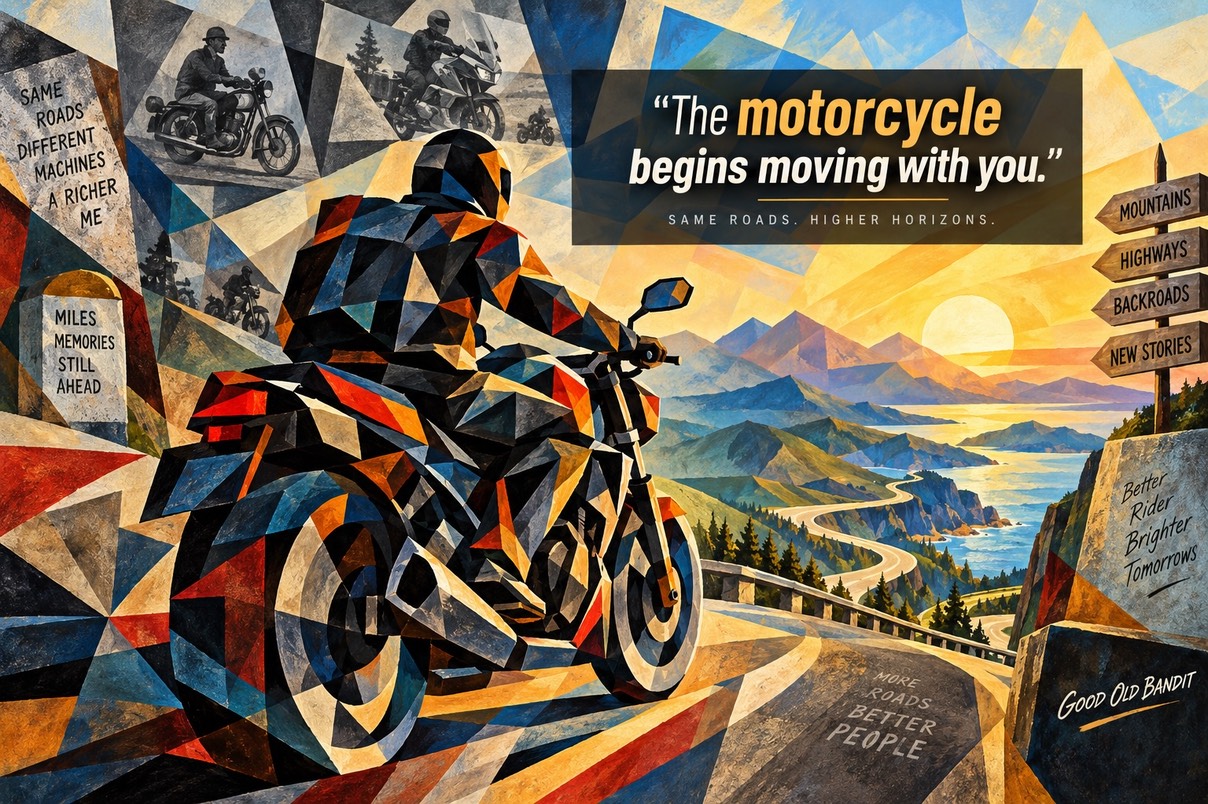
The motorcycle begins moving with you.
That moment is worth waiting for.
It may even keep you riding for the next forty years.
#MotorcycleLife #RideMore #TwoWheelsFreedom #MotorcycleControl #MotorcycleRiding #RiderLife #MotorcycleJourney #RidingExperience #MotorcycleCommunity #GoodOldBandit