

Revving Up Knowledge: Unveiling the Thrilling World of Motorcycle Fun Facts
The Machine Will Change, but the Ride Never Will

Good Old Bandit
A veteran rider reflects on petrol, electric, hydrogen, and the future of motorcycling through four decades on the open road.
Every generation believes it is riding through the biggest change in motorcycling. After more than forty years in the saddle, I have watched machines transform beyond recognition, yet the feeling that begins with a twist of the throttle remains untouched. The fuel may change, the technology will keep moving, but the ride has always been about something much deeper than the engine.
Every Generation Meets Its Own Revolution
Machines change, but the road keeps asking the same questions.
When I bought my first motorcycle, nobody spoke about battery chemistry, hydrogen fuel cells, or synthetic fuels. We talked about carburetors that refused to cooperate on cold mornings, spark plugs tucked away in worn leather tool rolls, and engines that had personalities as distinct as the people riding them.
Those machines demanded patience. They rattled, leaked, and occasionally tested your temper. Yet every ride carried a lesson that stayed with you long after the engine cooled.
I still remember one chilly morning before sunrise. The motorcycle refused to start. I kicked until my right leg begged for mercy. An elderly mechanic walked over with a quiet smile, adjusted the choke, listened for a moment, and said, "You're fighting the motorcycle instead of listening to it."
He was talking about far more than an engine.
That sentence has stayed with me for over four decades.
Motorcycles have always rewarded riders who pay attention. They ask for respect, not force. They remind us that progress never replaces experience. It simply builds upon it.
Today I hear passionate arguments every week. Some riders insist electric motorcycles will destroy everything that makes riding special. Others believe petrol engines belong only in museums. A few are convinced hydrogen will solve every problem we face.
After thousands of rides across highways, mountain roads, forgotten villages, and lonely stretches where the next fuel station seemed like wishful thinking, I have reached a different conclusion.
The motorcycle has never been the hero.
The rider always has.
That may sound simple, yet it changes the entire conversation.
People often confuse the machine with the experience. They mistake the sound for the freedom, the vibration for the adventure, and the fuel for the journey itself.
Those things matter. They always will.
They are not the whole story.
Every era has produced riders who believed the previous generation had the better motorcycles. I heard it when disc brakes replaced drums. I heard it when electronic ignition appeared. Riders argued against fuel injection with the same passion many reserve today for electric motorcycles.
Time has a remarkable habit of settling arguments that emotions refuse to settle.
The road has never cared whether your motorcycle burns petrol or stores electricity.
It only asks whether you are willing to ride.
The Sound That Lives Beyond the Engine
Memories stay long after the exhaust note fades.
I understand the emotional pull of an internal combustion engine because I have lived with it for most of my life.
There is something deeply satisfying about a well-tuned engine settling into a steady idle before sunrise. Every rider recognizes that familiar rhythm. It becomes part of your heartbeat before the ride even begins.
I have owned motorcycles that sang with smooth precision and others that sounded like they were determined to shake themselves apart before reaching the next town. I loved them all for different reasons.
One motorcycle carried me across endless highways during a summer that seemed determined to last forever. Another climbed rough mountain roads where the pavement disappeared without warning. One old machine stranded me beside a river for nearly half a day because a simple fuel line had cracked.
Oddly enough, that breakdown remains one of my favorite memories.
A local farmer noticed my frustration and invited me into his home while I waited for a replacement part from the nearest town. We shared tea, exchanged stories despite speaking different languages, and laughed at my stubborn attempt to repair the motorcycle with little more than optimism.
That afternoon reminded me something every experienced rider eventually understands.
Motorcycles introduce us to people as much as they introduce us to places.
No technology can replace that.
No battery chemistry or fuel source changes the kindness of strangers.
No engine note creates friendship.
People do.
That realization has become even stronger as motorcycles continue evolving.
Many riders say electric motorcycles have no soul because they lack the familiar sound of combustion. I understand the feeling because I once believed the same thing.
Then I spent time riding one.
The silence surprised me.
At first it felt unfamiliar, almost uncomfortable. I missed the mechanical conversation between engine and rider. Then something unexpected happened.
I started hearing everything else.
Wind moving through tall grass.
Birds lifting from roadside trees.
The distant sound of rivers hidden below mountain roads.
The laughter of children waving from village streets.
The motorcycle had become quieter.
The world had become louder.
That ride did not convince me to abandon petrol motorcycles.
It convinced me that every machine reveals a different side of the journey.
Good riders stay curious.
Great memories usually begin with curiosity.
The Price Every Machine Asks the Earth to Pay
Honest conversations begin by accepting uncomfortable truths.
The debate surrounding future transportation often becomes emotional because every side highlights only half the picture.
Some people claim electric vehicles are completely clean.
They are not.
Others insist petrol motorcycles are harmless because they have served humanity for over a century.
They are not.
Every motorcycle, regardless of its fuel, begins with the Earth giving something away.
Steel comes from mines.
Aluminum comes from mines.
Copper comes from mines.
Rubber comes from plantations.
Glass demands energy.
Plastic begins its life somewhere beneath the ground.
Nothing arrives without a cost.
The difference lies in where that cost appears and how long it continues.
Petrol asks the planet for something every single ride.
The fuel is extracted, transported, refined, delivered, and finally burned. Once burned, it cannot be recovered.
Electric motorcycles ask for much of their environmental cost before the first kilometer begins. Mining lithium, nickel, graphite, and other materials changes landscapes and affects communities. Those impacts deserve honest attention rather than convenient silence.
Yet those materials remain inside the battery. They are not meant to disappear forever.
That distinction matters.
It means future generations may recover and reuse much of what we remove today if recycling technology continues improving.
I often compare this to maintaining an old motorcycle.
Years ago, replacing worn parts usually meant buying new ones.
Today skilled mechanics restore components that previous generations simply discarded.
Engineering has always moved toward making better use of what already exists.
The transportation industry is slowly following that same path.
Young riders sometimes ask me which technology they should support.
My answer surprises them.
Support the engineers who make every technology cleaner.
Support companies that recycle instead of waste.
Support riders who respect the places they travel.
Support innovation that reduces harm without losing sight of freedom.
The badge on the fuel tank matters far less than the mindset behind the handlebars.
That is the conversation worth having.
As riders, we often speak about leaving tire marks across distant roads.
Perhaps our greatest achievement will be leaving fewer permanent marks upon the landscapes that welcomed us in the first place.
Tomorrow's Roads, Tomorrow's Machines
Technology keeps changing, yet freedom continues wearing two wheels.
Every few decades, motorcycling reaches another crossroads. Riders gather around coffee shops, fuel stations, and roadside cafés, convinced the next invention will either save the sport or destroy it forever. I have heard those conversations for more than forty years, and every generation believes its debate is unique.
The truth is far less dramatic.
Motorcycles have always evolved because riders demanded something better. We wanted more reliability. We wanted safer brakes. We wanted stronger frames, brighter lights, and engines that could carry us farther without complaint. Every improvement met resistance before it earned respect.
The conversation today has simply shifted toward energy.
Electric motorcycles have entered the scene with impressive performance. Hydrogen remains an exciting possibility. Engineers continue refining synthetic fuels. Battery chemistry improves almost every year, while researchers quietly chase ideas that sound impossible until they suddenly become practical.
I find that exciting rather than threatening.
Progress has never asked me to forget the motorcycles I loved. It simply invites me to imagine where the next generation might ride.
One afternoon, I found myself parked beside a young rider charging his electric motorcycle at a roadside stop. My machine had just finished taking petrol after another long stretch across open country. We smiled at each other before either of us spoke.
He walked over and admired my weathered motorcycle.
I admired his curiosity.
For nearly an hour we exchanged stories instead of opinions. He wanted to know what riding felt like before navigation apps, mobile phones, and electronic rider aids. I wanted to know what silence felt like on mountain roads with instant electric torque waiting beneath the throttle.
Neither of us tried to win the conversation.
We both left richer than we arrived.
That afternoon reminded me something every rider should remember.
Curiosity builds stronger bridges than certainty.
Motorcycling has never belonged to one generation. Every rider borrows it for a little while before passing it forward.
#FutureOfMotorcycling became part of our conversation without either of us planning it.
Beyond Petrol, Beyond Batteries
The next chapter may arrive from places we barely imagine today.
People often ask whether hydrogen will replace batteries or whether another technology will suddenly change everything.
My answer always begins with the same thought.
Nature rarely places all its strength inside one solution.
The transportation world probably won't depend upon a single energy source over the next century.
Passenger motorcycles may continue using lighter and more recyclable batteries. Long-distance touring could benefit from hydrogen if production becomes cleaner and storage improves. Synthetic fuels may keep classic motorcycles alive without relying upon fresh fossil fuel extraction. Aircraft and ships may follow different paths entirely because their challenges are different.
That diversity makes sense.
We never expected one motorcycle to suit every rider. We built cruisers for comfort, sport bikes for speed, adventure motorcycles for exploration, and lightweight machines for everyday travel.
Energy may evolve the same way.
What interests me most is not the race between technologies.
It is the growing effort to reduce waste.
Imagine batteries built almost entirely from recyclable materials. Imagine hydrogen created from abundant renewable electricity rather than fossil fuels. Imagine manufacturing powered by clean energy instead of coal and oil. Imagine motorcycles designed to last decades rather than becoming disposable products.
That future feels much more meaningful than arguing over which badge wins today's debate.
The greatest invention may not be a revolutionary engine.
It may be a revolutionary attitude.
The Horizon Beyond the Horizon
The greatest journeys always begin before anyone believes they are possible.
When I first started riding, nobody carried a computer inside their pocket. Maps folded awkwardly across fuel tanks. Weather forecasts were hopeful guesses. If someone had described today's motorcycles, most of us would have laughed politely before returning to adjusting carburetors beside the road.
That memory keeps me humble whenever someone claims we have reached the limits of engineering.
History disagrees.
One hundred years from now, riders may look back at today's motorcycles with the same affection we reserve for machines from the middle of the last century.
Perhaps advanced batteries will weigh almost nothing.
Perhaps hydrogen production will become remarkably efficient.
Perhaps nuclear fusion will provide abundant clean electricity across entire continents. Instead of worrying about producing enough energy, society may focus entirely upon storing and distributing it wisely.
Perhaps roads themselves will help recharge motorcycles while they travel.
Perhaps materials will be grown rather than mined.
Perhaps motorcycles will repair parts before riders even notice wear beginning.
Those ideas sound ambitious today.
So did fuel injection once.
So did anti-lock braking systems.
So did satellite navigation.
The future has always rewarded patient imagination.
As riders, we spend countless hours chasing distant horizons. We understand something the rest of the world often forgets.
The horizon always moves.
That is not failure.
That is the invitation.
The Soul That No Machine Can Manufacture
Freedom has never depended upon the fuel inside the tank.
Every rider eventually reaches a moment that explains everything.
Mine arrived during a quiet evening ride many years ago.
The sun had slipped behind distant hills. The road curved gently through farmland painted with the last warm light of the day. I stopped beside an old wooden fence simply because the moment deserved my full attention.
The engine ticked softly as it cooled.
There were no photographs.
No social media posts.
No audience.
Only silence.
Standing there, helmet resting on the seat, I realized the motorcycle had carried me somewhere far beyond geography.
It had carried me into gratitude.
That feeling never came from horsepower.
It never came from engine displacement.
It never came from the fuel inside the tank.
It came from movement.
From solitude.
From confidence earned one mile at a time.
From knowing I could point the front wheel toward an unfamiliar road and trust myself to find the way home.
Forty years later, that feeling remains exactly the same.
The motorcycle underneath me has changed.
The rider has changed.
The roads have changed.
The feeling has not.
That is the soul people speak about when they describe motorcycling.
The soul does not live inside pistons.
It does not hide inside batteries.
It certainly does not wait inside a hydrogen tank.
The soul lives inside the rider who chooses to keep exploring.
#RideMore and #MotorcycleLife mean far more than photographs of polished machines.
They represent curiosity that refuses to grow old.
They remind us that freedom is measured in experiences rather than kilometers.
That lesson becomes more valuable every passing year.
A Legacy Waiting for New Riders
Every experienced rider was once nervous at the end of the driveway.
Whenever I meet young people curious about motorcycles, I see a familiar mixture of excitement and uncertainty.
I recognize it because I carried those same feelings myself.
Every experienced rider remembers the first ride alone.
Every confident tourer remembers the first long journey that felt almost impossible.
Every veteran remembers making mistakes.
Those memories matter because they remind us that riding is never about proving anything.
It is about growing.
The next generation will ride motorcycles very different from the ones that shaped my life.
Their dashboards may resemble aircraft cockpits.
Their energy may come from sources still hidden inside research laboratories.
Artificial intelligence may quietly monitor safety without taking away the joy of control.
None of that worries me.
What matters is that young riders still experience the quiet confidence that arrives after completing a long ride.
I hope they still stop beside forgotten roads simply because the view deserves attention.
I hope they still wave at strangers riding in the opposite direction.
I hope they still help another rider whose journey has been interrupted by an unexpected problem.
Those traditions never needed petrol.
They never required batteries.
They only required people who understood that riding creates a community unlike any other.
If the next century produces cleaner motorcycles and healthier landscapes, every rider benefits.
If technology allows us to leave lighter footprints while keeping our sense of freedom intact, then the road ahead deserves our optimism.
After forty years on two wheels, I have become less interested in defending the past and far more interested in protecting the future.
That future belongs to every rider who has not yet thrown a leg over a motorcycle.
I hope they do.
Because no matter what powers tomorrow's machine, the road will still offer the same quiet promise it offered me all those years ago.
It will always whisper the same invitation.
Come and ride.
The future of motorcycling will not be written by a single company, a single fuel, or a single invention. It will be written by riders who refuse to stop exploring, engineers who refuse to stop improving, and communities that refuse to lose sight of the freedom that first brought us together.
I have watched motorcycles evolve through four remarkable decades. I have ridden machines that demanded strong legs and steady hands. I have ridden motorcycles filled with electronics that quietly worked in the background, making every journey safer without stealing the joy of riding. I have watched roads improve, traffic grow heavier, and conversations shift from horsepower to sustainability.
Every chapter has brought something worth appreciating.
Looking back, I rarely remember the specifications of the motorcycles that carried me across thousands of kilometers. I remember the mountain pass where clouds drifted across the road. I remember sharing tea with strangers after an unexpected breakdown. I remember laughing with fellow riders at roadside cafés after riding through relentless rain. I remember the silence of an empty highway before sunrise and the satisfaction of reaching home after days spent chasing distant horizons.
Those memories never depended upon the fuel inside the tank.
They depended upon the willingness to begin the ride.
That is the message I hope every young rider carries into the future.
Do not let endless arguments convince you that motorcycling is losing its spirit. The spirit was never trapped inside a carburetor, an exhaust pipe, a battery pack, or a hydrogen tank. It has always lived inside people willing to embrace uncertainty with confidence and respect.
Ride because the world looks different from behind a visor.
Ride because every journey teaches patience.
Ride because every mile builds quiet confidence that reaches far beyond the motorcycle.
Ride because the best conversations often begin after the engines stop.
Ride because every generation deserves the chance to feel the same excitement that riders have carried for more than a century.
The machine will keep changing.
The road will keep stretching toward another horizon.
The next breakthrough will arrive sooner than we expect, and another one will follow after that.
None of those changes can replace the simple feeling of rolling onto an open road with purpose in your heart and curiosity leading the way.
That feeling is timeless.
It belongs equally to the rider restoring a fifty-year-old classic, the commuter riding an electric motorcycle through city streets, the adventure rider crossing mountain trails, and the young dreamer standing in a showroom imagining the first ride.
Motorcycling has never been about preserving yesterday.
It has always been about carrying its finest traditions into tomorrow.
If we respect the Earth that gives us every road, welcome innovation without forgetting our roots, and continue sharing the fellowship that makes riders wave at complete strangers, then the next hundred years may become the greatest chapter this community has ever known.
I hope I meet many of you somewhere along that road.
I'll be the rider smiling beneath an old helmet, still believing that every meaningful journey begins with a simple decision.
Start the engine.
Charge the battery.
Fill the hydrogen tank.
Then ride.
1,800 Motorcycles and One Simple Truth.
Good Old Bandit
Why Barber Belongs on Every Rider’s List
Walk through a century of motorcycles at Barber and see why every old machine still has something to teach a young rider.
I have spent more than forty years around motorcycles, and one thing still stops me in my tracks: an old bike that has clearly lived a life.
It might be the shape of a fuel tank, a worn seat, an engine built before anyone had heard of ride modes, or a set of pipes that look ready to shake a quiet street awake.
That is why the Barber Vintage Motorsports Museum in Birmingham, Alabama, fascinates me.
Guinness named Barber the world's largest motorcycle collection in 2014. Today, it holds more than 1,800 motorcycles covering over a century of production, with more than 1,000 displayed at a time and machines from hundreds of makers across 22 countries.
Those numbers are impressive.
But the numbers are not the reason I want young riders to know this place.
The real story is what those motorcycles say about us.
A Thousand Different Answers to the Same Question
Why have people kept building motorcycles for more than a century?
When you have ridden for decades, you stop seeing motorcycles as a neat line from old and slow to new and fast.
Every era was trying to solve its own problem.
Some builders wanted more speed. Others wanted less weight. Some wanted a motorcycle tough enough for poor roads. Some wanted beauty. Some wanted race wins. Others simply wanted to give ordinary people a cheap way to get somewhere.
Walk through Barber and those ideas sit beside one another in steel, paint and rubber.
You see names that still rule showrooms and others that vanished long ago. Harley-Davidson, Honda and Indian share history with makers many young riders may never have heard of.
That matters.
Motorcycling has never belonged to one brand, one nation or one type of rider.
That is part of what makes #MotorcycleHistory worth knowing.
Old Motorcycles Make You Look Twice
They remind us how much riders once had to do for themselves.
My early motorcycles did not protect me from poor choices.
There were no screens telling me which riding mode I was in. No electronic safety net waiting quietly behind my right wrist. You listened to the motor. You watched the road. You learned what the front tyre was saying through the bars.
Modern motorcycles are better in countless ways, and I have no wish to turn the clock back.
Yet old machines carry something worth keeping: honesty.
You can look at an early motorcycle and almost follow the builder's train of thought. Engine. Tank. Wheels. Frame. Controls. Nothing seems hidden.
That mechanical link between rider and machine helped teach generations of us respect.
A motorcycle does not need to scare you to earn respect. It needs you to pay attention.
That is still true in the age of #ModernMotorcycles.
Machines Carry Human Stories
The best motorcycle museums are really museums about people.
I have never believed a motorcycle becomes worthless when the engine stops.
Look at one long enough, and you begin asking questions.
Who designed it? Who raced it? Who saved for it? Who rode it home for the first time? Which road did it know best?
Barber understands that history has value beyond price. The museum even notes that part of a vintage motorcycle's value lies in the history attached to the machine.
Forty years of riding has taught me the same lesson.
I remember motorcycles not by their spec sheets, but by mornings.
Cold starts. Fuel stops. Rain arriving twenty miles too soon. Tea beside a road. Friends appearing in a mirror behind me. An engine ticking quietly as it cooled after a long ride.
That is #RiderLife.
The motorcycle becomes part of the memory because it took you there.
The Past Should Make Young Riders Curious
Motorcycle culture survives only when another generation chooses to ride.
If you are young and motorcycles interest you, do not assume you need to know everything before you begin.
None of us did.
Start with curiosity.
Learn why motorcycles were built the way they were. Listen to older riders, but do not copy every habit they had. Respect the past without becoming trapped in it. Ride modern machines. Use modern safety gear. Build skill slowly.
Most of all, understand what you are joining.
Motorcycling is more than speed.
It is craft, design, risk, discipline, travel, friendship and independence compressed into two wheels.
A place such as Barber proves how deep that story runs. Its collection spans more than 100 years of motorcycle design and engineering.
You are not merely buying a bike.
You are entering a story that began long before you.
Keep the Engines in the Story
Some machines belong in museums. The spirit behind them belongs on the road.
One day, I would like every young rider to stand in a place like Barber and look across row after row of motorcycles.
Not because old bikes were better.
They were not.
Go there because each one is proof that someone cared enough to try something.
Someone drew it. Built it. Raced it. Improved it. Broke it. Fixed it. Rode it.
And somewhere in that vast room, a young person may look at one machine and think, I want to know what riding feels like.
That thought matters.
Forty years from now, the motorcycles will have changed again.
The reason we ride may not.
The road keeps changing. The need to feel alive on it does not.
#GoodOldBandit #Motorcycles #MotorcycleLife #MotorcycleHistory #BarberVintageMotorsportsMuseum #VintageMotorcycles #RiderLife #MotorcycleCulture #YoungRiders #TwoWheels #RideWithRespect
58 Riders, One Motorcycle
Good Old Bandit
What This Wild Record Really Says About Riding
58 people. One moving motorcycle. An Indian world record that says more about balance, trust, and riding than you may think.
I have spent more than four decades around motorcycles, and I still like the moments when a bike makes me stop and stare.
Sometimes it is an old machine parked outside a tea stall, its engine ticking as it cools. Sometimes it is a young rider leaning over a bike for the first time, trying to work out where all the controls go. And sometimes it is something so strange that even an old rider has to smile.
Like 58 people riding one motorcycle.
Yes, 58.
On 19 November 2017, the ASC Tornadoes Motorcycle Team in India put 58 people on one moving motorcycle in Bengaluru and earned a Guinness World Record.
At first, it sounds like pure madness.
Look closer, though, and you see something every rider learns sooner or later.
A motorcycle is all about balance.
Fifty-Eight People, One Point of Balance
The stunt looks wild. The skill beneath it is anything but.
When I first heard about the record, I did not think about the number.
I thought about the man holding the handlebars.
Anyone who has ridden long enough knows how alive a motorcycle feels beneath you. A passenger changes it. Luggage changes it. A full tank can change it. Even a hard side wind can make a familiar bike feel new.
Now imagine 57 other people depending on your control.
The Tornadoes did not beat physics. They worked with it. Their feat came from timing, trust, and huge amounts of practice. That is what makes the record worth talking about.
People often see motorcycling as speed and noise. Riders know there is another side to it.
Control.
That lesson has followed me through every kind of road I have ridden.
What My First Bikes Taught Me
Before speed comes feel.
The motorcycles of my early years were simpler than today's machines. There were no riding modes waiting to save a poor choice. You listened to the engine, felt the tyres through the bars, and learned what the bike was telling you.
Some lessons came gently.
Others came with a wobble, a stalled engine or a bruised ego.
I can still recall slow rides on narrow roads where keeping a steady line took more care than riding fast on an open highway. Those rides taught me something I still believe: going fast can make you feel skilled, but riding slowly often shows whether you are.
That is why the 58-rider record makes sense to me.
The great feat is not that a motorcycle carried so many people.
The great feat is that everyone worked together well enough to keep it upright and moving.
That is #MotorcycleLife in its purest form: balance, awareness, and respect.
A Motorcycle Magnifies Every Choice
The machine gives back exactly what you put into it.
A good motorcycle has never made me feel powerful in the way people often think.
It makes me alert.
You notice the road surface. You notice rain before it starts falling hard. You notice the smell of fields, the drop in air as you enter a valley, and the first orange line of sunrise before the cars around you seem awake.
You also become aware of your own state.
Are you tense? Tired? Angry? Distracted?
A motorcycle tells you.
That honesty is one reason I have kept riding for so long.
The machine does not care how old you are, how impressive your job sounds, or how many people follow you online. It asks only whether you are present.
That is a good lesson for a young rider.
Why India Produces Riding Stories Like This
Here, motorcycles have always meant more than leisure.
The Tornadoes record also feels very Indian.
In this country, motorcycles are woven into daily life. They carry workers, students, families, soldiers, travelers and dreamers. They squeeze through cities, climb mountain roads and roll across villages where four wheels still feel too large for the lane.
Our bond with motorcycles is practical, but it is also emotional.
For many of us, the first bike meant freedom.
I remember that feeling well. The road suddenly became larger than the neighborhood around you. A town that once felt far away became an evening ride. A hill road became an invitation.
That feeling has never fully left me.
Perhaps that is why I still look at a motorcycle before a ride with the same small spark of joy.
#RideIndia is not just about where you go. It is about how the road changes the way you see distance, people, and yourself.
The Record Is Impressive. The Real Journey Is Better
You do not need 57 passengers to find out what riding can teach you.
Young riders sometimes feel that motorcycling must be dramatic to matter.
It does not.
Your best memory may never involve a racetrack, a stunt or a mountain pass.
It may be your first clean start from a traffic light. Your first dawn ride. Your first solo trip beyond your city. Or the first time you park the motorcycle after a long day and realize that you feel calmer than when you left.
Those moments stay.
After more than 40 years, I remember many roads. Yet what I value most is not speed.
It is the sense of being part of the journey instead of watching it through glass.
That is the gift of motorcycling.
The Tornadoes put 58 people on one motorcycle and showed the world what balance and teamwork can achieve.
Most of us will never attempt anything close to that, nor should we.
But every rider can learn the same deeper lesson.
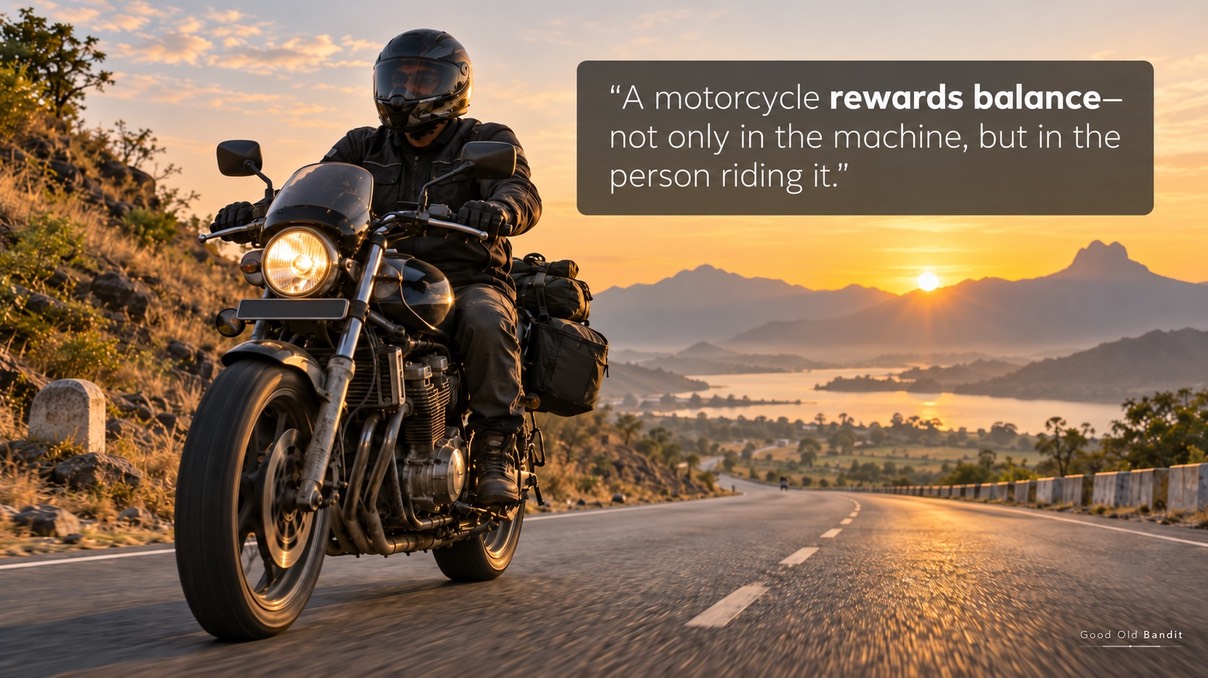
A motorcycle rewards balance—not only in the machine, but in the person riding it.
If you are young and motorcycles keep catching your eye, take that interest seriously. Learn well. Respect the machine. Respect the road. Ride with people who value skill more than showing off.
Then go see where two wheels take you.
Forty years later, you may still be finding out.
#MotorcycleLife #RideIndia #Motorcycling #YoungRiders #MotorcycleCulture #TwoWheels #RiderLife #OpenRoad #GoodOldBandit