
Unleashing the Thrills of Motorcycles
The First Track Day Stays with You
Good Old Bandit
First track day nerves, speed, braking, confidence, and motorcycle wisdom, told through four decades of riding experience.
A racetrack does something strange to a motorcyclist. It removes traffic, crossroads, dogs, buses, and excuses. What remains is you, your motorcycle, and every habit you brought along. After forty years of riding, I still believe a first track day reveals more than speed. It reveals the rider beneath the helmet.
Leave the Hero at the Gate
Your first track day begins long before the motorcycle reaches the circuit.
My earliest motorcycles never had riding modes, traction control, or glowing dashboards. They had carburetors, stubborn kick-starters, questionable electrics, and personalities you respected very quickly.
One old machine taught me that lesson before I understood its value. I entered a bend faster than my ability deserved. The motorcycle protested, my arms stiffened, and the road suddenly looked very narrow.
Nothing dramatic happened, thankfully. I simply emerged shaken and considerably less impressed with myself.
That memory returns whenever I see a young rider entering a circuit. There is usually excitement, nervous energy, and perhaps a little theatre. Somebody has new leathers. Somebody has a louder exhaust. Somebody already looks ready for qualifying.
None of that matters once the visor comes down.
A first track day is not an examination of courage. It is a conversation between your hands, eyes, judgement, and motorcycle.
The smartest rider in the paddock often looks rather ordinary. That rider asks questions, listens carefully, and gives the first session proper respect.
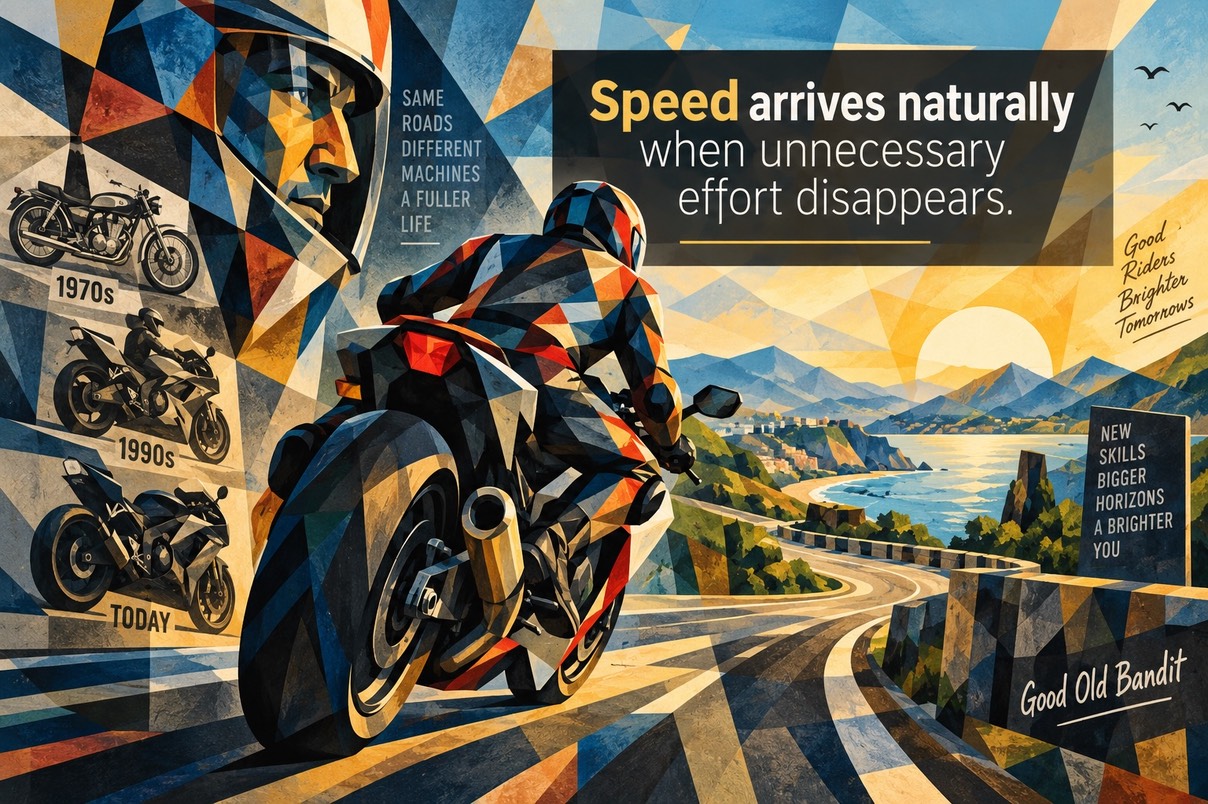
Forty years on motorcycles has taught me one stubborn truth. Speed arrives naturally when unnecessary effort disappears.
Trying to look fast usually creates the opposite result. Shoulders tighten, braking becomes abrupt, lines become messy, and vision narrows.
Leave the performance for another day.
Your first circuit visit should build #MotorcycleConfidence rather than bruise it.
The stopwatch can wait.
Give the Motorcycle Some Respect First
Confidence grows faster when the machine beneath you deserves your trust.
I once started a long highway ride with a chain needing attention. I knew it before leaving home, yet impatience won the argument.
Every few kilometres, that dry mechanical clatter reminded me of my laziness.
I reached my destination, but the motorcycle had occupied my thoughts all morning. A ride loses its rhythm when part of your mind keeps waiting for trouble.
A circuit magnifies that feeling.
Before my motorcycle enters any track, I want the basics beyond doubt. Tyres must be healthy, brakes must feel right, and fluids must stay where they belong.
The chain deserves proper adjustment and lubrication. Controls should operate cleanly, without strange resistance or unnecessary play.
Track organizers may also have requirements concerning mirrors, lights, number plates, or loose accessories. Listen carefully during the technical inspection and rider briefing.
Tyre pressures deserve the same respect.
Do not copy a random number from another rider's motorcycle. Different tyres, machines, conditions, and riding speeds create different requirements.
Speak with the trackside tyre technician or experienced circuit staff. That conversation costs nothing and can remove considerable uncertainty.
The same thinking applies to riding gear.
Good leathers, gloves, boots, back protection, and a proper helmet are not decorations. They allow you to concentrate because your preparation has already answered several uncomfortable questions.
Years ago, riding gear was far less sophisticated than today's equipment. I appreciate modern protection every single time I put it on.
Respecting tradition does not mean refusing progress.
A beautiful old motorcycle deserves affection. A modern machine deserves appreciation for everything engineers have added between generations.
Both still demand the same thing from the rider: attention.
The First Session Is for Listening
Those opening laps tell you far more than chasing somebody's tail section ever will.
The first time I rode through mountain mist, I remember reducing my pace dramatically. Visibility had disappeared, the road surface felt uncertain, and familiar corners looked completely different.
Nothing about the motorcycle had changed.
The environment had changed, so the rider needed to change with it.
Your opening track session deserves exactly that attitude.
The tarmac feels different from public roads. Corners arrive differently, braking zones seem unusually wide, and familiar speed references disappear.
Take those first laps as an introduction.
Feel the throttle. Feel the brakes. Notice the corner entries and the places your eyes naturally travel.
Listen to the motorcycle beneath you.
A circuit does not need to be attacked immediately. It needs to become familiar enough that your brain stops treating every corner as new information.
That takes time.
Young riders sometimes feel embarrassed when others disappear ahead. Nothing is embarrassing about allowing faster riders to leave.
I have been overtaken by younger riders on smaller motorcycles. I have also passed larger motorcycles while riding machines with far less power.
Neither moment proved very much.
Track days reveal an amusing truth about motorcycling. Horsepower attracts attention, but calm riding often travels surprisingly quickly.
That patience sits at the centre of #TrackDayRiding.
Your Eyes Usually Arrive Before the Motorcycle
Vision changes everything once speed begins compressing your available thinking time.
The biggest transformation in my riding came without buying anything.
I started looking farther ahead.
That sounds almost insultingly simple. Yet riders often stare at whatever frightens them.
A pothole receives all their attention. A gravel patch becomes enormous. A corner exit disappears because their eyes remain trapped near the front wheel.
I remember one wet ride through the hills many years ago. Water crossed the road repeatedly, and the surface offered very little reassurance.
The moment I stared at each wet patch, my riding became tense. When I looked through the road instead, the motorcycle began feeling calmer.
Track riding amplifies that connection between eyesight and movement.
Your motorcycle tends to follow your attention. Look through the corner rather than emotionally attaching yourself to the apex.
Once the corner starts opening, move your attention toward the exit.
That visual rhythm creates mental space.
You begin processing the next moment before reaching it.
At first, everything may seem to happen quickly. After several sessions, familiar reference points begin slowing the experience down.
You recognize where braking starts. You recognize where the corner tightens. You remember where the exit becomes visible.
Suddenly, the circuit feels less like a blur.
The track has not slowed.
Your mind has simply stopped arriving late.
Smooth Riding Has Always Aged Well
Technology changes quickly, but a calm throttle hand remains wonderfully timeless.
I have ridden motorcycles that demanded genuine mechanical sympathy. A careless throttle hand could make an old carbureted machine cough, surge, or complain immediately.
Modern motorcycles hide many rough edges brilliantly.
Fuel injection is cleaner. Electronic rider aids can be remarkable. Engines produce power that once belonged to racing dreams.
Yet poor inputs remain poor inputs.
A harsh throttle opening still unsettles weight transfer. Sudden braking still asks the front tyre an abrupt question.
Tension still travels through your arms and into the handlebars.
Track riding makes smoothness visible.
The rider who looks relaxed often carries more speed than expected. That person is not fighting the motorcycle between every corner.
The controls flow into one another.
Braking finishes with intention. Steering arrives cleanly. Throttle returns with patience as the motorcycle finds its exit.
That is where #RideSmooth earns its meaning.
My favorite road memories rarely involve maximum speed. I remember stretches where rider and motorcycle seemed to agree.
There was no wrestling and no frantic correction.
The machine simply moved beneath me, and my hands stopped interfering.
A racetrack offers a concentrated version of that feeling.
Once you experience it, speed becomes less important than rhythm.
Oddly enough, rhythm eventually brings speed with it.
Braking Confidence Beats Braking Bravado
The strongest braking zones are built through consistency rather than last-second heroics.
Every rider remembers a braking moment that sharpened their judgement.
Mine came on an old highway before divided roads became common. A truck moved unexpectedly across my path, and every metre suddenly mattered.
I stopped safely, but the experience stayed with me.
Braking is not merely squeezing a lever. It involves judgement, grip, weight transfer, vision, and timing.
A circuit gives riders something public roads rarely provide: repetition.
The same corner returns every lap.
That makes braking points useful anchors.
Choose conservative reference points at first. Notice a marker, surface change, board, or other fixed reference approved during the briefing.
Brake with control and give yourself margin.
As confidence develops, your sense of distance becomes clearer. You may eventually adjust those points under proper track instruction.
There is no prize for frightening yourself into a corner.
Late braking looks impressive from the fence. Predictable braking feels much better from the saddle.
The most valuable first-day feeling is simple.
You want to know that when your fingers ask for braking, your mind already expects the result.
That trust frees attention for everything happening next.
Body Position Should Serve the Motorcycle
Forget the photograph and let movement follow function.
Social media changed the image of track riding.
Young riders now see spectacular photographs before ever entering a circuit. Knees skim kerbs, elbows approach the ground, and motorcycles appear impossibly leaned over.
Those images are exciting.
They can also make a newcomer chase body position before understanding its purpose.
I grew up in a riding era where photographs were rare. Nobody saw most of our rides except the people standing beside us.
That had disadvantages, but it also removed an audience.
On your first track day, your body should help the motorcycle rather than imitate somebody else.
Stay relaxed through your shoulders. Avoid locking your elbows or hanging desperately from the handlebars.
Allow your lower body to support movement.
As cornering becomes comfortable, your position will begin making more sense. A track coach can then correct details that photographs never explain properly.
Knee sliders are replaceable pieces of material.
Confidence is harder to replace.
I have watched riders scrape knees while running untidy lines. I have also watched experienced riders move quietly and disappear into the distance.
One looks dramatic.
The other usually understands the motorcycle better.
#MotorcycleTrackDay culture becomes far richer when riders celebrate control alongside spectacle.
Ride Your Session, Not Somebody Else's
The rider ahead can become useful information or unnecessary temptation.
This may be the hardest first-track-day lesson.
Someone will pass you.
Possibly several people.
One of them may ride a smaller motorcycle. Another may look far more relaxed while doing it.
Let them go.
I remember being passed years ago on a twisting road by an older rider. His motorcycle carried less power, and his movements looked almost lazy.
Naturally, my younger ego wanted to follow.
Within three corners, I understood the difference between copying pace and possessing ability.
I stopped chasing.
That decision probably taught me more than following him ever could.
The racetrack offers safer conditions, yet the principle remains unchanged.
Another rider's braking point belongs to that rider. Their tyres, experience, motorcycle, confidence, and understanding may differ completely.
Do not borrow their speed without possessing their judgement.
If an instructor asks you to follow, that becomes different. A controlled session can reveal lines and visual references quickly.
Random chasing produces very little except pressure.
Track riding becomes deeply satisfying once comparison starts fading.
Your real conversation is with the person who entered the circuit during the previous session.
Was your vision calmer this time?
Did the braking zone feel clearer?
Did your hands relax?
Did the corner exit arrive without panic?
Those improvements matter.
The Paddock Is Part of the Experience
Some of the best track-day wisdom appears after the engines become quiet.
Motorcycling has always introduced me to people I might never have met otherwise.
I have shared roadside tea with strangers whose names disappeared from memory. I still remember their motorcycles, jokes, and generosity many years later.
Track paddocks carry that same spirit.
Take the helmet off and conversations begin naturally.
Someone asks about your tyres. Another rider mentions a corner where you seem tense.
An experienced hand may notice something you never recognised from the saddle.
Listen without feeling judged.
Riders who have spent years around circuits usually respect newcomers who arrive with curiosity and sensible restraint.
There is enormous value in asking an instructor about one corner. One useful correction can improve every lap that follows.
The paddock also reminds you to rest.
Track sessions create physical and mental fatigue faster than many newcomers expect. Heat, concentration, braking forces, and protective clothing quietly drain energy.
Drink water. Eat sensibly. Sit down between sessions.
If concentration disappears, missing one session is wiser than forcing another.
I have cut rides short because my attention felt wrong.
Motorcycles will always offer another road.
A circuit will still be there after lunch.
Experience does not mean ignoring fatigue. Experience means recognising it earlier.
Fear Deserves a Seat, Not the Handlebars
Every serious rider has felt fear, whatever stories are told later.
There is a peculiar pressure among motorcyclists to pretend fear does not exist.
I have never understood that.
Fear has visited me on wet highways, loose mountain roads, night rides, mechanical failures, and unfamiliar motorcycles.
It has also visited me on racetracks.
Fear carries information.
Sometimes it says you are entering too quickly. Sometimes it tells you fatigue has arrived.
Sometimes it simply reacts because everything feels unfamiliar.
Listen to the message without surrendering control.
If a session feels overwhelming, return to the paddock.
Remove your helmet. Drink something. Think about what unsettled you.
Perhaps one corner feels confusing. Perhaps you followed somebody too quickly.
Perhaps your braking confidence disappeared.
Return with one thought rather than ten ambitions.
That approach has served me across decades of riding.
Motorcycling rewards riders who can separate discomfort from danger.
The distinction becomes clearer with experience, yet nobody becomes immune to uncertainty.
Courage is not pretending fear vanished.
Courage is remaining thoughtful while it sits beside you.
Forget the Lap Timer for a While
Your first great track-day achievement may never appear on a screen.
Numbers can become addictive.
Lap times, speeds, lean angles, tyre temperatures, braking data, and onboard telemetry now reach ordinary riders easily.
I appreciate modern technology.
Used properly, data can reveal patterns that feelings sometimes hide.
Still, I would keep the stopwatch out of a newcomer's head initially.
A lap timer creates a question before the rider understands the circuit.
“Was that faster?”
A better first-day question asks something very different.
“Was that cleaner?”
Clean riding creates a foundation that timing can measure later.
I remember finishing an early circuit session convinced I had ridden brilliantly. Someone experienced quietly mentioned my shoulders looked locked throughout several corners.
He was right.
The next session felt slower because I concentrated on relaxing.
It was also better.
That distinction remains important.
Motorcycling offers plenty of numbers. Engine capacity, horsepower, torque, acceleration, speed, mileage, and price all compete for attention.
None of them fully describe a great ride.
You know a great ride by the silence inside your helmet.
Everything becomes clear for a few corners.
That feeling is worth chasing.
The Ride Home Feels Different
The circuit often changes your road riding more deeply than your track riding.
My favorite part of many track days comes after everything finishes.
The leathers feel heavy. The motorcycle carries bits of rubber and dust.
Your body feels pleasantly tired.
Then you ride home, or load the motorcycle for the journey back.
Something has changed.
You notice your vision has improved. You feel more conscious about braking.
You recognize tension in your arms sooner.
You may even ride public roads more slowly.
That surprises newcomers.
A circuit gives speed a proper place.
Once you experience acceleration and cornering inside a controlled environment, proving anything on public roads starts feeling unnecessary.
That may be one of track riding's greatest gifts.
Public roads contain too many variables.
Children cross streets. Animals wander. Oil appears without warning. Drivers change direction without noticing you.
The track gives enthusiasm somewhere healthier to breathe.
That is one reason I encourage younger riders toward #TrackDayExperience when circumstances allow.
Motorcycling does not need reckless behavior to remain exciting.
Quite the opposite.
Greater understanding makes the machine more fascinating.
Four Decades Have Not Removed the Excitement
Age changes the reasons for riding, but the spark remains wonderfully familiar.
When I think about my early motorcycles, I remember their imperfections first.
Cold starts required patience. Brakes demanded planning. Headlights offered optimism rather than illumination.
Yet those machines opened a world.
They carried me across highways that looked very different then. They brought friendships, breakdowns, arguments, rainstorms, wrong turns, and unforgettable mornings.
Modern motorcycles astonish me.
The power, brakes, suspension, tyres, electronics, and reliability would have seemed extraordinary forty years ago.
Still, the essential experience has barely changed.
You sit astride a machine.
You start the engine.
The world suddenly feels closer.
A first track day concentrates that relationship into a few kilometres of tarmac.
You begin noticing things street riding often hides.
You feel weight shifting under braking. You sense tyres loading through corners.
You hear the engine differently because traffic noise has disappeared.
Most importantly, you start understanding your own habits.
That is the part worth carrying home.
The First Track Day Is Only the Beginning
The real reward is becoming a more thoughtful rider every time the visor closes.
Forty years of motorcycling have given me enough memories to fill several garages.
Some involve beautiful roads. Some involve miserable weather.
A few involve motorcycles I still wish I had never sold.
Many involve mistakes.
That is motorcycling.
Nobody begins complete.
A first track day should not make you feel inadequate. It should make the road ahead feel larger.
You may return wanting more circuit time. You may decide racing interests you.
You may simply become calmer on Sunday rides.
All are worthwhile outcomes.
Motorcycling has never needed everyone to ride for the same reason.
Some riders chase distant horizons. Others chase corners.
Some restore old machines in quiet garages. Others embrace the latest electronics and engineering.
The motorcycle makes room for all of us.
Arrive at your first track day with curiosity rather than expectation.
Respect the motorcycle, the circuit, the people around you, and your present ability.
Then ride.
Let the experience unfold one session at a time.
Years later, you probably will not remember your first lap time.
You will remember closing the visor.
You will remember entering pit lane.
You will remember that strange mixture of nervousness and excitement.
And somewhere during the day, you may feel that rare moment every rider understands.
The motorcycle stops feeling like something beneath you.
For several perfect seconds, it simply becomes part of the journey.
That feeling kept me riding for more than forty years.
I suspect it will keep another generation riding too.
The Long Arc of a Corner.
Good Old Bandit
Countersteering and the Quiet Art of Riding
Countersteering reveals the balance, trust, and instinct that make motorcycle cornering one of riding’s deepest pleasures.
A motorcycle corner can tell you more about yourself than a long straight road ever will. After more than forty years of riding, I still feel that small moment of trust before a bike leans. Countersteering sits inside that moment, almost invisible, yet central to everything that follows.
The First Time a Motorcycle Answers Back
The moment when steering stops feeling mechanical and starts feeling alive
My first machines were simple, noisy, and forgiving only when treated with respect. They had narrow tyres, modest brakes, and engines that announced every complaint without hesitation. I did not know the phrase counter steering during those early riding years. I only knew motorcycles changed direction through a strange and beautiful conversation.
On a quiet road outside town, I first noticed that conversation clearly. I wanted the motorcycle to move left around a gentle, open bend. My hands made a tiny movement at the bars, and the machine leaned almost immediately. The response felt completely natural, though the reason behind it remained hidden.
Years later, proper words finally caught up with that familiar riding sensation. Press forward on the left handlebar, and the motorcycle starts leaning toward the left. Press forward on the right, and the same process begins toward the right. The front wheel initially turns slightly away, creating conditions that start the motorcycle leaning.
Once the lean develops, the steering settles naturally into the turning arc. It happens quickly enough that most riders barely notice the individual movements. At normal road speeds, the entire sequence feels like one fluid response.
That explanation sounds backward when discussed away from a motorcycle. From the saddle, the movement soon feels completely natural and instinctive. Counter steering is not some mysterious technique reserved for racers. It belongs to the basic physics that allows a moving motorcycle to corner.
At walking speeds, motorcycles can behave quite differently and accept more direct steering. Once speed builds, counter steering becomes increasingly important for controlling lean and direction. Most experienced riders already use it, even without thinking about the name.
What stayed with me was never the technical terminology behind the movement. I remembered the feeling of a machine answering one calm and measured input. There was no wrestling with the motorcycle and no need for unnecessary force. The bike simply responded once I stopped trying to overpower its natural movement.
That lesson has travelled beside me through decades of #Motorcycling and countless roads. Good riding rarely comes from trying to dominate a motorcycle through physical strength. It grows when rider and machine begin speaking the same mechanical language.
Counter Steering Beneath the Surface
A small input creates the lean that makes motorcycle cornering possible
At road speed, a motorcycle must lean before its path tightens through a corner. Countersteering begins that lean by changing forces acting between tyres, momentum, steering geometry, and gravity. The movement happens quickly, but the result shapes almost every meaningful road corner.
The physics can become complicated once every contributing force enters the conversation. Gyroscopic effects play a part, while tyre forces and steering geometry matter greatly. Yet the feeling experienced at the handlebars remains beautifully simple for any rider.
A small pressure at the correct handlebar can create a powerful directional response. That relationship between small input and large movement fascinated me from my earliest years. It still fascinates me after thousands upon thousands of corners.
I remember a fast-sweeping road through the hills many years ago. The surface looked clean, visibility stretched ahead, and the motorcycle felt beautifully settled. I entered one long bend carrying more speed than my younger self usually trusted.
For one brief second, instinct encouraged me to tighten both arms unnecessarily. Experience was beginning to tell me something quieter and much more useful. I stayed loose, pressed gently on the inside handlebar, and trusted the motorcycle.
The bike came onto the intended line without argument or sudden drama. Everything became calmer the instant my steering input became calmer and more deliberate. I remember leaving that bend with an entirely different understanding of cornering.
Confidence had not arrived because I suddenly became braver or faster. It arrived because I finally understood the relationship between action and response. That difference matters more than many young riders initially realize.
Countersteering gives riders more than the ability to change direction quickly. It gives them a precise physical relationship with a motorcycle's lean angle. That precision matters on mountain roads, open highways, and ordinary urban streets.
Modern motorcycles make that relationship wonderfully clear through their chassis and tyres. Frames have become stiffer, tyres offer remarkable grip, and suspension responds with impressive control. Yet the principle working beneath every electronic aid remains largely unchanged.
I have ridden motorcycles that required patience before committing themselves to a bend. Other machines seemed ready to reach an apex almost before I finished thinking. Every motorcycle speaks with its own accent, but the underlying grammar remains familiar.
That continuity keeps #MotorcycleCornering endlessly interesting after more than forty years. Machines keep changing, yet the fundamental conversation between rider and motorcycle remains direct. Very few mechanical experiences still feel quite that honest.
Fear, Vision, and the Shape of a Bend
The motorcycle often reflects the calmness carried through your hands
Every rider eventually meets a corner that refuses to match expectations. The radius tightens, the road narrows, or the surface suddenly looks uncertain. Those moments connect countersteering with something far less mechanical than physics: fear.
I remember one wet afternoon travelling along an old hill road. Rain had turned dusty patches into a thin and unpleasant brown film. One particular bend tightened halfway through, while the outside edge dropped sharply toward a valley.
My first instinct was completely human and completely unhelpful in that moment. My eyes moved toward the edge of the road that worried me. Almost immediately, the motorcycle began drifting toward the same uncomfortable place.
I brought my vision back toward the open road through the corner. My arms softened, and I pressed the inside handlebar with greater purpose. The motorcycle tightened its line calmly and carried both of us through.
Several kilometers later, I stopped beside a small roadside tea stall. My hands were steady, but my mind remained firmly inside that corner. The uncomfortable truth was simple: the motorcycle had responded faithfully to my inputs.
Riding exposes the connection between attention and physical action with remarkable honesty. Tension changes steering inputs, while vision influences where those inputs tend to lead. Countersteering works beautifully when the rider remains deliberate instead of reactive.
Experience does not remove fear from motorcycling or from difficult roads. Fear still visits me occasionally after more than forty years in the saddle. The difference is recognizing its voice before allowing it to control my hands.
Young riders sometimes picture veterans as people who eventually stopped feeling frightened. I have never believed that description of experience or skilled riding. Good riders respect fear while leaving enough mental space for judgement.
Countersteering becomes incredibly valuable during exactly those demanding moments on the road. It gives the motorcycle one clear request when panic wants several conflicting ones. A calm steering input can completely change the emotional shape of a corner.
That truth extends beyond motorcycling without needing any grand philosophical speech. Calm decisions often begin through small actions rather than dramatic last-second corrections. Motorcycles simply make that truth difficult for any rider to ignore.
The Roads That Changed My Hands
Different surfaces teach different meanings of control, patience, and trust
Highways taught me patience, while backroads taught me sensitivity and anticipation. Broken roads added humility faster than either of those earlier teachers. Forgotten trails showed me that control always remains partly a negotiation.
On smooth tarmac, counter steering can feel almost surgical through the handlebars. A small pressure can adjust lean angle with beautifully satisfying accuracy. Rough roads keep the same principle alive but add another important demand.
The rider must allow the motorcycle some freedom to move beneath them. Trying to correct every tiny movement can quickly create another unnecessary movement. I understood that most clearly during one particularly long day of riding.
The road had been repaired so many times that every corner looked different. Sections of asphalt seemed assembled from several generations of highway maintenance. My motorcycle moved constantly beneath me and rarely felt completely settled.
Initially, I tried responding to almost every twitch through the handlebars. My constant corrections only made the entire motorcycle feel busier and more nervous. Eventually, fatigue persuaded me to become gentler with my hands.
Once I loosened my grip, the motorcycle began finding its natural balance. My role became selecting direction, speed, and commitment rather than controlling every movement. That distinction remains among the most valuable truths motorcycling has given me.
Countersteering does not mean constantly making steering corrections through every corner. Good cornering often begins with one clean input and then becomes quieter. A motorcycle needs space to settle after receiving a clear message.
Adventure motorcycles made this relationship especially obvious during later years of riding. Wider handlebars amplify modest pressure, while longer suspension moves more beneath the rider. Sport motorcycles communicate similar principles through sharper geometry and faster reactions.
Older roadsters tend to speak their cornering language with greater patience. Heavy touring machines carry momentum with a deep and deliberate physical feeling. Each motorcycle rewards a different touch, yet very few reward panic.
That is where genuine #RidingExperience becomes far more valuable than bravado. Miles eventually expose habits that confidence and ego can successfully hide temporarily. They reveal when action helps and when another correction simply creates trouble.
The best riders I have encountered were rarely the loudest personalities around motorcycles. Most carried an easy manner, sharp awareness, and quiet respect for conditions. Their motorcycles looked settled because their minds usually appeared settled as well.
Machines Remembered Through Corners
Some motorcycles stay with us because of the way they moved
I remember motorcycles less through horsepower figures than through physical sensations. Certain engines remain vivid, but particular corners often survive even longer in memory. A motorcycle reveals much of its personality once the road stops running straight.
One older motorcycle demanded genuine patience before entering every meaningful bend. Its chassis moved gently, while the front tyre communicated through narrow handlebars. Rushed inputs upset it, but smooth commitment produced an unexpected and graceful rhythm.
Another machine, encountered many years later, felt almost telepathic by comparison. Gentle pressure at the handlebar produced an immediate and beautifully controlled response. The contrast between those motorcycles showed me something important about engineering progress.
Modern engineering can make motorcycle cornering faster, easier, and more predictable. It cannot replace judgement, attention, patience, or respect for changing road conditions. Electronic systems support thoughtful riders rather than manufacturing thoughtful riders by themselves.
I appreciate anti-lock braking, traction control, excellent tyres, and sophisticated modern suspension. I equally appreciate the old habit of watching road surfaces carefully. There is no conflict between old riding instincts and modern motorcycle technology.
The strongest riders I know comfortably carry both worlds inside their riding. They respect basic motorcycle physics while enjoying everything modern engineering now offers. They value mechanical feel without rejecting systems that can improve rider safety.
Counter steering fits perfectly into both generations of motorcycle design and thinking. It existed long before dashboards became screens filled with digital information. It will remain relevant while motorcycles continue balancing themselves dynamically on two wheels.
Something is reassuring about that continuity across different generations of machines. Beneath changing engines and fashions, the same basic physical relationship keeps working. The rider presses, the motorcycle leans, and another corner begins opening ahead.
Cornering as a Conversation
The best turns feel less like control and more like agreement
There comes a moment inside a good corner when everything feels settled. The tyres hold their line, suspension breathes, and the engine carries steady drive. Your hands become quiet because the motorcycle already understands the chosen direction.
Those moments continue bringing me joy after more than four decades. They never needed extraordinary speed to make themselves memorable or satisfying. Their pleasure comes from that rare feeling of complete agreement between rider and machine.
Counter steering begins that agreement through a clear and purposeful physical request. The rider establishes lean, while balance and throttle support everything that follows. The corner becomes one continuous movement instead of several disconnected corrections.
Years ago, I followed an older rider through several bends before sunrise. His motorcycle looked neither particularly powerful nor especially glamorous beside newer machines. Yet every line he selected appeared measured, economical, and completely unhurried.
At a roadside stop, I asked about his remarkably relaxed cornering style. He laughed and said he had stopped fighting corners many years earlier. That simple sentence stayed with me longer than many technical explanations.
The finest motorcycle cornering often looks almost uneventful from outside the saddle. Inside the helmet, that calmness can feel deeply and quietly satisfying. The absence of unnecessary drama becomes part of the achievement itself.
That is what makes #CounterSteering worth understanding beyond technical terminology. It removes the mistaken belief that cornering demands great physical strength. Precision consistently beats force, while confidence grows naturally from clear and measured inputs.
For younger riders, that realization can transform their relationship with motorcycling. Riding stops becoming a contest between human strength and mechanical behavior. It becomes a partnership built through attention, patience, and increasing sensitivity.
That partnership explains why #RideMore still carries meaning after so many years. Every thoughtful ride creates another opportunity to become smoother and more observant. There is always another corner capable of showing you something new.
A Place for Young Riders
Motorcycling still offers something rare in an increasingly distracted age
Young people now live among more screens and alerts than my generation imagined. Almost every quiet moment seems ready for another notification or digital interruption. Motorcycling offers a wonderfully sharp contrast to that increasingly fragmented experience.
A moving motorcycle demands presence because roads refuse to tolerate divided attention. That demand can feel intimidating during someone's earliest days around motorcycles. It can also become one of riding's greatest sources of freedom.
For an hour, decisions belong to speed, distance, weather, space, and movement. The world becomes immediate again, with very little room for digital distraction. There is enormous satisfaction inside that temporary simplicity and concentration.
Counter steering captures much of that feeling within one tiny physical action. A light handlebar input changes the entire attitude of the motorcycle immediately. There are no menus, loading screens, notifications, or software delays between intention and response.
I want more young riders to experience that unusual mechanical clarity firsthand. I do not want them chasing reckless speed, attention, or online approval. I want them experiencing the satisfaction of becoming genuinely connected with a motorcycle.
There is joy in reading a corner properly before reaching its entrance. There is joy when a motorcycle settles underneath you through changing bends. There is also satisfaction in reaching home knowing your judgment improved slightly.
Motorcycling creates unusual friendships across age, profession, language, and social background. I have shared roadside tea with strangers because motorcycles brought us together. The parked machines usually handled introductions before either rider said very much.
Some of my favorite road conversations lasted no longer than fifteen minutes. We exchanged road conditions, motorcycle stories, mechanical complaints, and several predictable jokes. Then we rode toward opposite horizons and never encountered each other again.
Those brief meetings carry an honesty that other social spaces sometimes lack. Riders understand that every journey includes private moments photographs cannot properly capture. That shared understanding creates community without demanding elaborate explanations from anybody.
For anyone considering motorcycling, that remarkable world remains very much alive. The motorcycles have changed considerably, while the invitation remains almost the same. Patience, proper training, protective equipment, and respect make strong companions at the beginning.
A young rider does not need enormous horsepower to understand motorcycling. Some of my richest memories came aboard machines offering very modest performance. What mattered was having another road ahead and enough curiosity to ride it.
The Corner That Never Really Ends
Experience changes the rider much more deeply than it changes the road
After more than forty years, certain corners still command my full attention. Familiar roads change after rain, repairs, traffic, heat, or simple neglect. Even familiar motorcycles reveal fresh details when approached with renewed concentration.
That constant change keeps motorcycling deeply alive for me after decades. Mastery never arrives as some final certificate carried inside your jacket. It appears through small moments when judgement becomes cleaner than yesterday.
Counter steering represents that endless progression particularly well for experienced riders. The basic action remains simple, while its meaning grows steadily with experience. A new rider feels the lean, while an older rider notices its surroundings.
I notice grip pressure, road camber, wind, tyre feedback, and available sightline. I notice whether a bend invites patience or allows a tighter approach. I also notice when my own mind has become unnecessarily hurried.
The motorcycle reflects every one of those details without flattering the rider. Two wheels leave surprisingly little room for pretending concentration exists when absent. That mechanical honesty becomes deeply compelling once you begin respecting it.
Some rides leave behind no grand story worth telling around dinner. They might be ordinary evening loops through completely familiar neighborhood roads. Yet those simple rides can reset the mind and sharpen neglected senses.
That remains the quiet gift waiting inside life on #TwoWheels. Riding transforms ordinary movement into attention and attention into lasting experience. Countersteering transforms intention into lean, while the road completes the conversation.
The deeper meaning arrives somewhere between intention, trust, and motion
Counter steering sits at the heart of motorcycle cornering and rider control. Its deeper value reaches far beyond the movement happening at the handlebars. It quietly teaches trust without carelessness and confidence without unnecessary arrogance.
I have felt those lessons on old motorcycles and sophisticated modern machines. They appeared on mountain roads, forgotten trails, crowded streets, and tired highways. The scenery changed constantly, while the central feeling remained remarkably familiar.
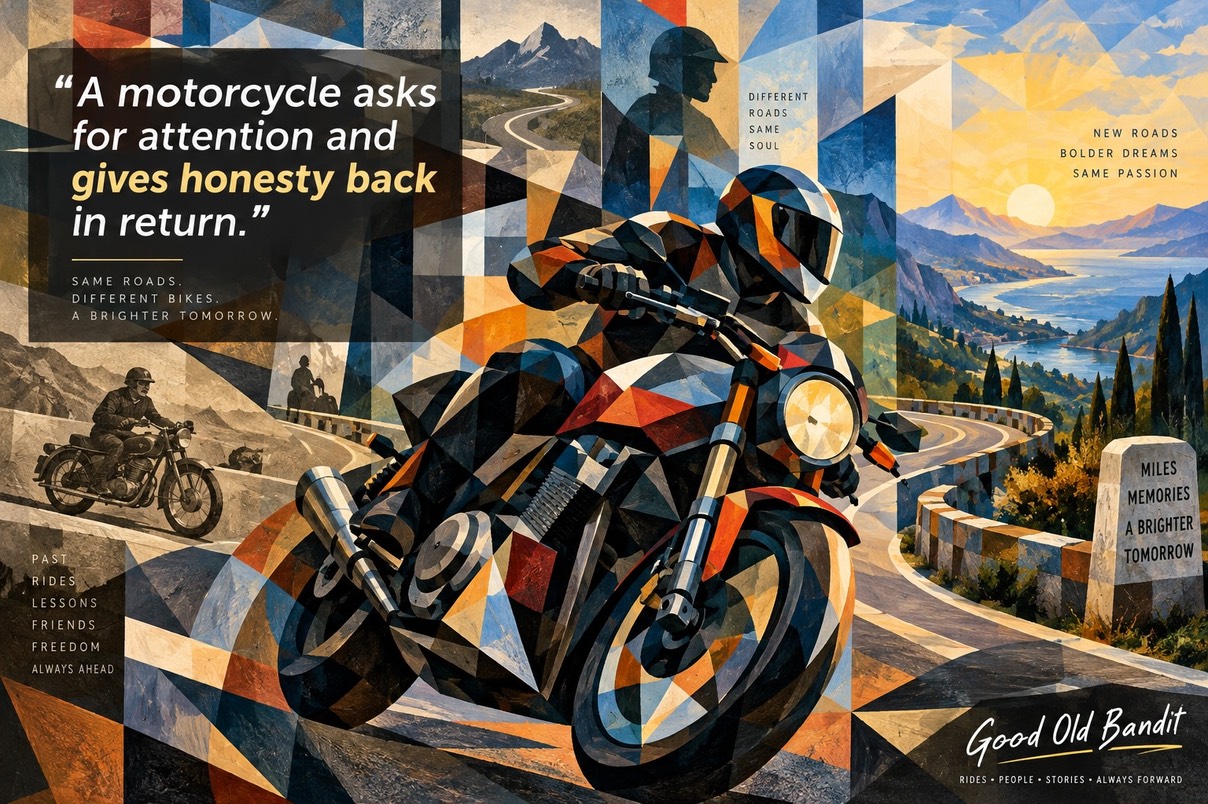
A motorcycle asks for attention and gives honesty back in return. Press the handlebar, feel the lean, and stay engaged with the road. That relationship becomes richer through every thoughtful mile spent aboard two wheels.
Young riders still have every reason to enter this extraordinary world. Motorcycling offers freedom, skill, community, concentration, and a rare sense of presence. It asks for respect, yet returns experiences difficult to reproduce elsewhere.
My earliest motorcycles would appear crude beside many machines available today. Yet the sensation that first hooked me remains waiting inside every generation. Somewhere between straight road and leaning motorcycle, something deeply human still happens.
After more than forty years, the corners continue calling me back. I suspect they will keep calling for as long as I ride.
#Motorcycling #MotorcycleCornering #CounterSteering #RidingExperience #RideMore #TwoWheels #MotorcycleLife #RiderConfidence #Cornering #MotorcycleRiding #GoodOldBandit