
Unleashing the Thrills of Motorcycles
The Motorcycle Moves with You
Good Old Bandit
Forty Years of Finding Control on Two Wheels
Four decades of riding reveal a simple truth: real motorcycle control begins with the rider’s body, balance, trust, and feel.
A motorcycle remembers every careless input your body makes. It also rewards every moment when rider and machine finally agree. After forty years on two wheels, I believe body positioning is less about technique than conversation. Your motorcycle speaks through its bars, tyres, suspension, and seat. The best rides begin when you stop shouting back.
The First Time the Motorcycle Felt Alive
Control begins when a machine stops feeling like an object beneath you
My earliest motorcycles never had riding modes, traction control, or colorful screens. Some barely had dependable electrics.
What they offered was something far more valuable. They made every mistake painfully clear.
I still remember an early morning ride on a small two-stroke many decades ago. The road was narrow, patched, and empty except for the occasional bus. I entered one bend carrying more enthusiasm than judgement.
My shoulders tightened before the corner even arrived. My arms followed, then my hands squeezed the bars harder. Suddenly, the motorcycle seemed unwilling to turn.
At that age, I blamed the motorcycle.
Older riders will smile at that sentence.
Years later, I understood what happened. The motorcycle had not become difficult. I had become difficult.
My entire upper body was fighting an otherwise willing machine.
That lesson has followed me across highways, mountain roads, gravel tracks, and city traffic. Motorcycles respond strongly to the person sitting upon them.
Body positioning for motorcycle control begins there.
A stiff rider can make a wonderful motorcycle feel nervous. A relaxed rider can bring remarkable calm to an ordinary machine.
The difference becomes obvious once enough kilometers pass beneath your wheels.
Motorcycling gradually teaches you that strength matters less than sensitivity. The motorcycle rarely needs wrestling when everything underneath you work correctly.
It wants clear inputs.
More importantly, it wants a rider who can feel what happens after making them.
That relationship still fascinates me after four decades.
The Day I Stopped Fighting Corners
A relaxed body creates space for the motorcycle to finish its work
There was a mountain road years ago that changed my understanding of cornering forever.
It climbed through forest before opening into long, sweeping bends. The surface changed constantly between smooth tar, broken edges, and damp patches.
I was riding with another motorcyclist who seemed almost annoyingly effortless.
He was not dramatically faster.
He simply looked calm.
His motorcycle leaned beneath him without the little corrections I kept making. His shoulders remained loose while mine carried unnecessary tension.
At a tea stop, we spoke about the road.
He never offered a lecture. He simply mentioned that I looked busy on the motorcycle.
That sentence stayed with me.
On the next stretch, I stopped trying to control every movement. I allowed my knees, hips, shoulders, and head to move more naturally.
Something changed immediately.
The motorcycle stopped feeling reluctant.
Corners opened instead of closing around me. Steering inputs became smaller, and my vision travelled farther ahead.
The motorcycle had been capable all morning. I had finally stopped interfering with it.
That remains one of my strongest memories about proper motorcycle body position.
People often picture body positioning as dramatic racetrack movement. Real roads usually ask for something quieter.
They ask for balance.
They ask for relaxed arms and an upper body capable of moving freely. They ask your head to remain connected with the road ahead.
Your body should support motorcycle control rather than interrupt it.
That sounds simple because it is simple.
Simple does not mean easy.
A Motorcycle Feels Your Fear Before Anyone Else Does
Tension travels directly from the rider into the machine
Every long-term rider eventually meets fear.
Anyone claiming otherwise probably has a selective memory.
I once crossed a stretch of road during heavy rain with visibility disappearing rapidly. Trucks threw sheets of water across my visor, while standing water appeared without warning.
The motorcycle underneath me was perfectly healthy.
My confidence was not.
My hands slowly began tightening around the grips.
Then my shoulders rose.
Then every small movement from the front tyre felt enormous.
Fear had changed my body positioning before anything dangerous actually happened.
That distinction matters.
A frightened rider often becomes rigid. A rigid rider reduces the motorcycle’s freedom to move underneath them.
Modern motorcycles hide some of this beautifully. Their chassis, suspension, tyres, electronics, and brakes can compensate for remarkable amounts of clumsiness.
Yet physics remains remarkably old-fashioned.
Your motorcycle still responds to weight, pressure, movement, and tension.
I eventually eased my grip during that rainstorm. I stopped treating every movement beneath me as a warning.
The machine settled.
More importantly, I settled.
We reached a roadside shelter several kilometres later, soaked despite our waterproof clothing. Another rider arrived soon afterwards on an old Bullet.
We drank terrible tea from tiny paper cups.
Nobody spoke about courage.
There was nothing heroic about that morning.
We had simply respected the conditions and kept ourselves composed.
Those experiences shaped my understanding of riding more than any perfect sunny road.
Motorcycle confidence is not the absence of fear.
It is the ability to stay connected with the machine when fear appears.
That connection begins physically.
Your breathing changes your shoulders. Your shoulders influence your arms. Your arms influence the bars.
Everything travels somewhere.
The motorcycle notices.
Old Machines Demanded Attention
Earlier motorcycles revealed every unnecessary movement a rider made
I have enormous affection for older motorcycles.
I also remember their faults clearly enough to avoid pretending everything was better then.
Brakes could be optimistic. Tyres offered surprises. Frames occasionally felt more philosophical than structural.
Yet those motorcycles had tremendous honesty.
A badly positioned rider could feel the consequences almost immediately.
Ride stiffly across broken roads and the handlebars reminded you. Carry your weight awkwardly through a bend and the chassis answered.
Sit carelessly during hard braking and everything seemed to arrive through your wrists.
Old motorcycles demanded participation.
I remember riding a powerful machine from that era for the first time. Its engine seemed far more talented than its brakes or suspension.
The throttle opened with real authority.
Every corner then required respect.
That motorcycle taught me something important about body positioning. Your position affects more than cornering style.
It affects braking stability, steering effort, fatigue, visibility, and confidence.
When my lower body supported me properly, my hands became calmer.
When my torso stayed balanced, braking became less dramatic.
When my head stayed upright, and eyes travelled forward, the motorcycle felt smaller beneath me.
These connections became instinctive slowly.
Nobody becomes an accomplished rider during one memorable Sunday.
Thousands of ordinary kilometers shape good motorcyclists.
Traffic shapes them.
Rain shapes them.
Bad roads shape them.
Long evenings returning home shape them.
That is part of the beauty behind #MotorcycleLife. The motorcycle keeps revealing something about your habits.
Sometimes the revelation is flattering.
Often it is not.
Modern Motorcycles Changed Everything Except the Rider
Electronics advanced rapidly, while balance and body awareness remained timeless
Today’s motorcycles are extraordinary.
Even modest machines now offer braking, tyres, suspension, and engine performance once reserved for expensive motorcycles.
I respect that progress enormously.
I have no desire to return to weak headlights merely because they looked charming.
Yet modern technology creates an interesting illusion.
A capable motorcycle can make poor habits invisible for surprisingly long periods.
Cornering ABS can protect a rider from certain mistakes. Traction systems can soften careless throttle inputs.
Modern tyres offer levels of grip that would have seemed magical forty years ago.
None of this makes body awareness less important.
It makes good body positioning even more rewarding.
Modern motorcycles respond beautifully when the rider works with their design.
The difference appears during long rides.
A rider who constantly grips the motorcycle through the arms becomes tired quickly. Every braking zone places more strain through wrists and shoulders.
A balanced rider spreads the work through the entire body.
The motorcycle also feels lighter.
I remember riding a modern machine through a series of fast open bends after years aboard older motorcycles. The precision felt almost unbelievable.
Yet the greatest pleasure came from something familiar.
My body still mattered.
A slight shift through the torso changed the motorcycle’s attitude. Relaxed elbows allowed subtle steering corrections without disturbing the chassis.
Looking through the bend remained as important as ever.
Forty years of engineering progress had not removed the rider from the equation.
That makes me happy.
Motorcycling still demands presence.
The Road Beneath Your Feet Changes the Conversation
Broken roads and forgotten trails reveal another side of rider balance
Some of my favorite riding memories have happened far away from perfect tarmac.
There is a different honesty about a rough road.
Loose stones, sand, broken surfaces, mud, and deep ruts remove unnecessary confidence very quickly.
Years ago, I followed a narrow track that looked harmless from the main road. Within twenty minutes, it had become a badly broken trail.
Turning back seemed sensible.
Naturally, I continued.
The motorcycle moved underneath me far more than expected. At first, every slide triggered an immediate reaction from my arms.
The more I fought those movements, the worse everything became.
Eventually fatigue forced me to loosen up.
That helped.
The motorcycle began finding its own path through smaller disturbances. My legs absorbed movement that my arms had previously tried to control.
I stopped expecting the bike to remain perfectly still.
That was the real breakthrough.
Motorcycle balance does not always mean keeping the machine motionless beneath you.
Sometimes control means allowing movement.
That idea carries beautifully from dirt into road riding.
A motorcycle needs room to breathe over bumps, cambers, painted lines, gravel, and uneven surfaces.
Young riders sometimes expect perfection from themselves too quickly.
They watch polished videos where every corner looks clean. Every movement appears deliberate and confident.
Real riding is messier.
You occasionally enter a corner awkwardly.
You misjudge a road surface.
You take the wrong line.
You get tired.
You have days when the motorcycle simply does not feel right beneath you.
Those moments matter because riding develops through them.
#RideMore should never mean chasing speed or proving courage.
It should mean gathering experience patiently.
Your Eyes Pull the Rest of You Along
Good body positioning starts long before the motorcycle reaches the corner
One thing has remained true across every motorcycle I have ridden.
The body usually follows the eyes.
A rider staring close to the front wheel often becomes physically cramped. Everything happens late because the road seems to arrive suddenly.
A rider looking farther ahead tends to open naturally.
The head turns.
The shoulders follow.
The torso becomes prepared for the road rather than surprised by it.
I experienced this strongly during a long solitary ride many years ago.
The highway eventually narrowed into flowing country roads just before sunset. There was almost no traffic.
I remember noticing that my attention had changed.
I was no longer thinking about the motorcycle.
My vision simply moved through the road, and my body followed without conscious effort.
Those are rare moments.
Every experienced rider knows them.
You stop operating the motorcycle and begin travelling with it.
Engine sound, wind pressure, body position, road surface, and vision seem to merge.
Nothing mystical has happened.
You have simply become completely present.
That feeling keeps people riding for decades.
Speed alone could never explain our attachment to motorcycles.
Presence explains much more.
Young Riders Bring Something Motorcycling Still Needs
New generations keep the culture alive without needing to imitate older riders
I sometimes hear older motorcyclists complain about younger riders.
They mention smartphones, riding videos, fashionable equipment, or modern motorcycles filled with electronics.
Every generation believes the next one has somehow missed the point.
I disagree.
Young riders bring energy into motorcycling.
They bring different motorcycles, different destinations, and different ideas about what riding can become.
They also inherit better safety equipment and far better machines.
That should be celebrated.
What deserves preserving is not some imagined golden age.
It is the relationship between rider, motorcycle, and road.
Body positioning sits quietly inside that relationship.
When you begin sensing your motorcycle through your feet, knees, hips, hands, and shoulders, riding changes.
The machine stops becoming transport.
It becomes something you participate in.
That experience does not belong to older riders.
It belongs to anyone willing to ride with attention.
Your first motorcycle does not need enormous power.
Your first journeys do not need famous mountain passes.
Some of the strongest memories come from ordinary roads near home.
I still remember evening rides covering distances that seem laughably small today.
They felt enormous then.
Every unfamiliar road represented possibility.
Every stop beside the motorcycle felt like ownership of a larger world.
If #TwoWheelsFreedom means anything to me, it means exactly that.
Motorcycles expand your map before they expand your speed.
Control Feels Quiet When It Finally Arrives
The best riders rarely look like they are working very hard
There is a wonderful contradiction at the center of motorcycle control.
The better you become, the less dramatic good riding begins to feel.
Your movements become smaller.
Your grip becomes lighter.
Your body stops making unnecessary corrections.
You recognize problems earlier, so fewer situations become emergencies.
Body positioning becomes part of that quiet efficiency.
There is no single posture for every motorcycle, rider, surface, or corner.
A cruiser, adventure motorcycle, sports machine, and old roadster each create different relationships with your body.
Yet the underlying conversation remains familiar.
Balance yourself without locking the motorcycle beneath you.
Support your body without asking your wrists to carry everything.
Stay loose enough to feel movement without reacting to every movement.
Let your vision prepare the rest of you for what approaches.
These ideas sound technical when placed on paper.
On the road, they become feelings.
That difference matters.
Motorcycling survives in memory through feelings.
I remember cold handlebars before sunrise.
I remember engines refusing to start outside remote tea shops.
I remember brilliant roads interrupted by terrible surfaces.
I remember motorcycles I sold and immediately missed.
Most strongly, I remember moments when everything came together.
The motorcycle felt balanced.
My body felt relaxed.
The road seemed to unfold at exactly the right pace.
That is #MotorcycleControl at its finest.
Nothing spectacular needs to happen.
You simply feel connected.
The Rider Becomes Part of the Machine
After more than forty years of riding, motorcycles still surprise me.
Machines have changed beyond recognition, yet the heart of riding remains wonderfully familiar.
Your body tells the motorcycle what kind of rider has arrived today.
Calm or tense.
Attentive or distracted.
Patient or rushed.
Good body positioning does not make motorcycling beautiful by itself.
It creates space for the beauty to reach you.
When your body stops fighting the motorcycle, you feel more of everything.
You feel the tyre working across changing surfaces.
You notice the suspension settling after a bump.
You sense the weight moving during braking and acceleration.
You become part of the motorcycle’s movement rather than baggage sitting above it.
Young riders have an extraordinary road ahead.
There are better motorcycles, better equipment, and more ways to connect with other riders.
Still, some things cannot be downloaded, purchased, or rushed.
They arrive through kilometers.
They arrive through mistakes, rainstorms, wrong turns, empty roads, and mornings started before sunrise.
One day, somewhere on an ordinary road, the motorcycle suddenly feels different.
Nothing on the machine has changed.
You have.
Your shoulders loosen. Your hands become lighter. Your eyes travel farther down the road.
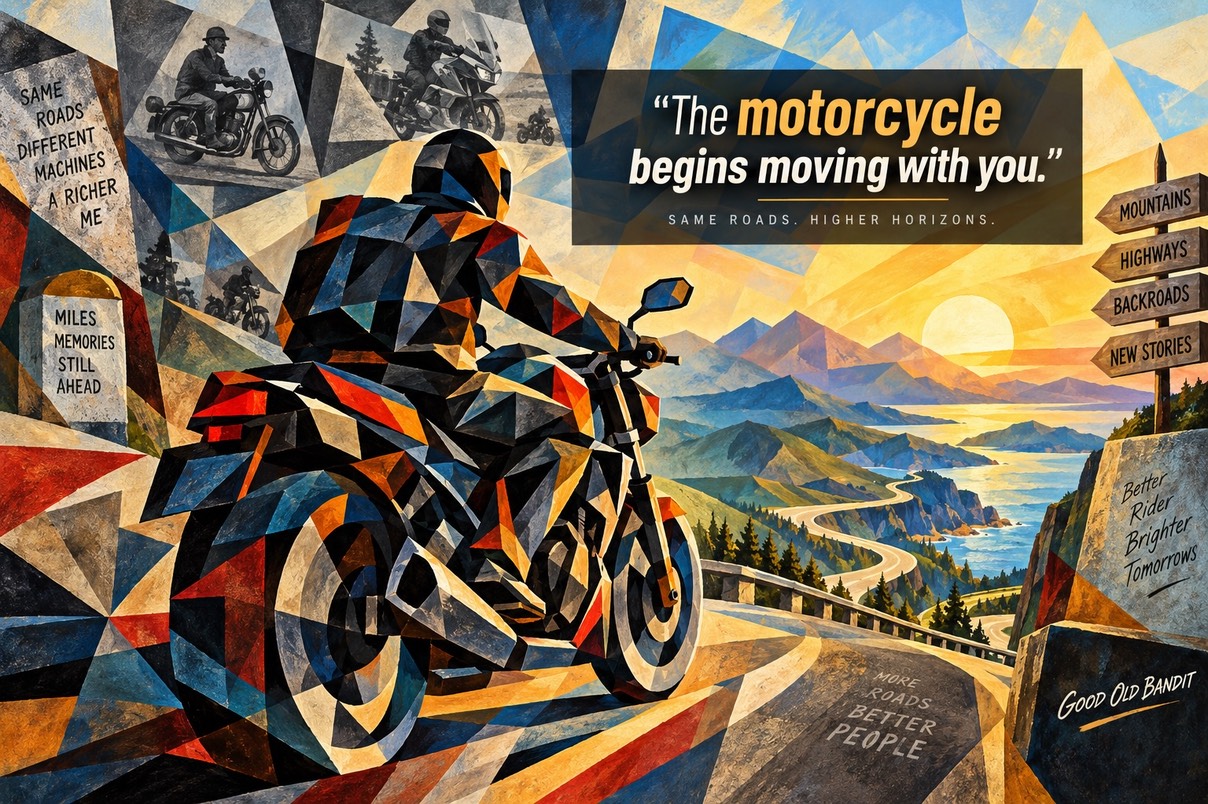
The motorcycle begins moving with you.
That moment is worth waiting for.
It may even keep you riding for the next forty years.
#MotorcycleLife #RideMore #TwoWheelsFreedom #MotorcycleControl #MotorcycleRiding #RiderLife #MotorcycleJourney #RidingExperience #MotorcycleCommunity #GoodOldBandit
The Stop That Every Rider Should Be Ready For
Good Old Bandit
Emergency braking is more than technique. It is calm, control, instinct, and the experience that keeps a rider moving forward.
Forty years of riding teaches you something strange about motorcycles. The finest moments are rarely about speed. Sometimes, they are about stopping. A child crossing a road, gravel after a bend, or traffic freezing ahead can change everything. In those seconds, your motorcycle reveals your habits, and you discover the rider you have become.
The Moment the Road Changes
Every long riding life contains a few seconds that never completely leave you.
My earliest motorcycles were simple machines with equally simple expectations. They started, they rattled, and they demanded your full attention.
There were no electronic riding modes watching over your shoulder. Brakes required respect, tyres had limits, and roads offered regular surprises.
I remember one afternoon from those early years very clearly. I was travelling along a narrow road outside town after light rain.
The surface looked harmless, though patches of mud sat quietly near the edges. A bus suddenly stopped ahead without much warning.
I remember my fingers closing around the brake lever. I also remember the motorcycle becoming very light beneath me.
Nothing dramatic happened, which remains the important part of that memory. I stopped with enough road left and continued riding.
Yet those few seconds stayed with me for decades. They taught me something speed never could.
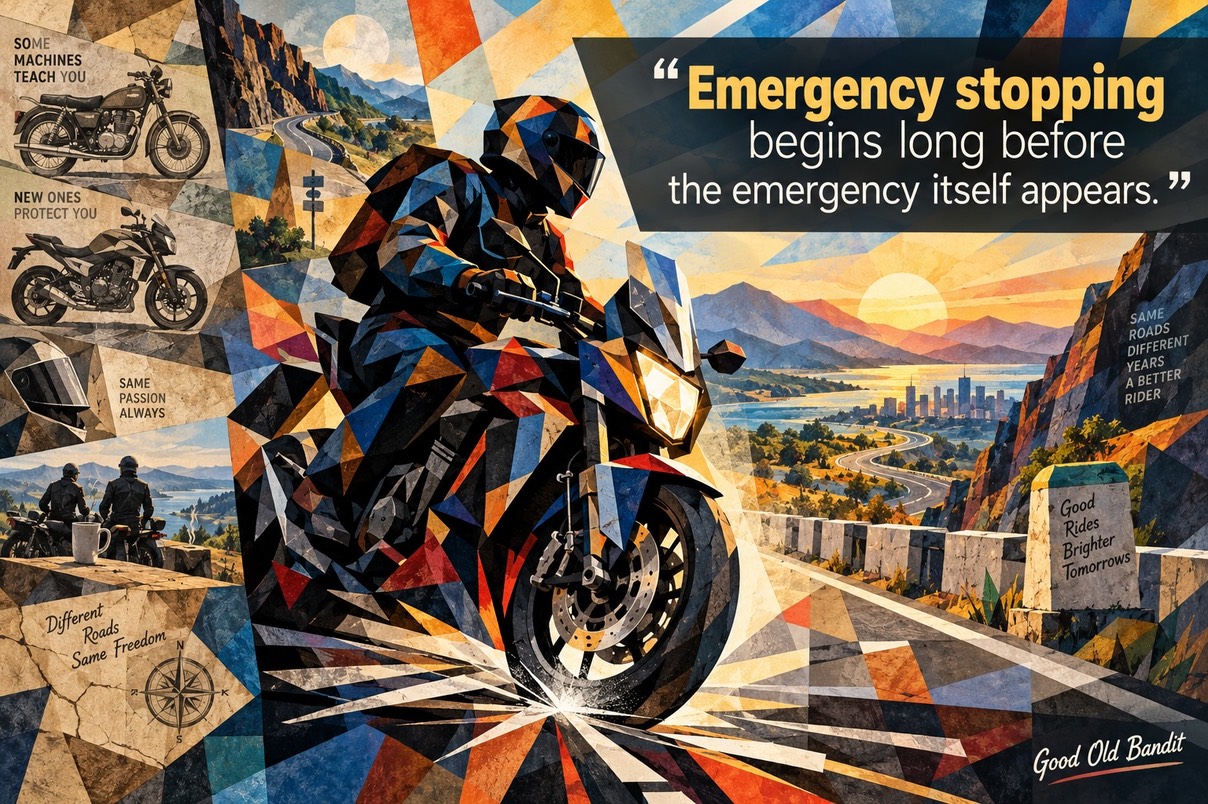
Emergency stopping begins long before the emergency itself appears.
It develops through every ordinary junction, every wet road, and every controlled stop made without thinking much about it.
That is one of motorcycling's great truths. Your everyday habits become your emergency reactions.
Young riders often admire cornering photographs and acceleration figures. I understand that completely because I once did the same.
Yet braking confidence creates a different kind of freedom. You ride knowing the motorcycle can lose speed as confidently as it gains speed.
That confidence is part of real #MotorcycleSafety, though it never needs to feel dull.
It can make riding more enjoyable.
Your Hands Remember Before Your Mind Does
Good braking becomes instinct only after calm repetition has made it familiar.
A genuine emergency rarely sends an invitation beforehand. Something changes, and suddenly the available road becomes painfully short.
Your first reaction matters because panic loves abrupt movements. Motorcycles usually respond better to firm, progressive actions.
Through the years, I have watched riders grab the front brake suddenly. I have also seen riders almost ignore it completely.
Both reactions usually come from fear rather than understanding.
The front brake carries much of the stopping work as weight transfers forward. The rear brake adds stability and useful braking force.
Modern ABS has made those difficult moments much more forgiving. I welcome that development without hesitation.
Some older riders speak about electronics as though hardship created better motorcyclists. I have never believed that.
A safer motorcycle gives a rider more room to develop. Skill and technology should support each other.
Even with ABS, the rider's input still matters greatly. A smooth, strong squeeze allows the tyre and suspension to settle.
I once rode an older Japanese machine through a mountain road before sunrise. It had good brakes for its era.
A dog appeared from behind a parked truck near a village. There was almost no warning.
My fingers tightened progressively rather than snatching the lever. My foot pressed the rear brake at nearly the same moment.
The motorcycle settled hard onto its front suspension. The dog disappeared across the road, completely unaware of my pounding heartbeat.
I stopped, breathed, and looked at the empty lane ahead.
That motorcycle had no clever electronics saving the situation. What helped was repetition developed over many quieter stops.
Today, ABS provides another valuable safety layer. The basic relationship between rider and machine remains.
Your hands need familiarity before fear arrives.
That is #RideSafe in its most practical form.
The Front Wheel Tells the Truth
Grip changes constantly, and experienced riders never assume yesterday's road exists today.
Tyres give motorcycles their astonishing ability to accelerate, corner, and stop. They perform everything through remarkably small contact patches.
That fact has kept me humble for decades.
A dry highway can offer tremendous braking grip. The same road becomes another place after rain, sand, diesel, or loose gravel.
I remember crossing Rajasthan years ago during a long summer ride. The highway stretched ahead under brutal afternoon heat.
A tractor joined the road unexpectedly from a dusty track. Fine sand had gathered where both surfaces met.
I had enough distance, but the lesson remained sharp. Road surface matters as much as braking strength.
When the motorcycle is upright, braking forces work more cleanly through the tyres. During cornering, grip already carries another responsibility.
That changes everything.
If danger appears while leaned over, reducing lean becomes valuable whenever space permits. A straighter motorcycle can devote more grip toward stopping.
That principle sounds almost too simple. On the road, it becomes one of those ideas worth carrying forever.
The machine constantly communicates through the bars, suspension, tyres, and seat. Riders gradually become better listeners.
This listening is one reason motorcycling remains fascinating after four decades. There is always another layer to understand.
I have ridden motorcycles far faster than my first machine. I have ridden machines with sophisticated suspension and excellent ABS.
Yet a patch of gravel still deserves respect.
Experience does not remove risk. It improves your relationship with it.
Panic Is Fast, Calm Is Faster
The strongest emergency response comes from control rather than aggression.
People often imagine an emergency stop as a violent act. In reality, the best ones can feel surprisingly controlled.
You see danger, close the throttle, apply both brakes, and keep your attention ahead.
The front suspension compresses as weight moves forward. The motorcycle sheds speed with an urgency you rarely request during normal riding.
The clutch also becomes relevant as the motorcycle slows sharply. Pulling it prevents the engine from fighting the final part of the stop.
Yet none of these movements should feel like separate commands. With practice, they become one coordinated response.
Years ago, another rider and I were returning home after a long day. Evening traffic had started building near the city.
A car cut across two lanes toward an exit. The rider ahead of me stopped quickly and cleanly.
I remember watching his shoulders afterward. They remained loose rather than locked with panic.
That image stayed with me.
A tense rider often makes tense control inputs. A relaxed rider gives the motorcycle space to work.
Nobody remains perfectly calm during every surprise. Forty years on motorcycles does not turn anyone into stone.
Your heart can still jump. Your mouth can still go dry.
The aim is not eliminating fear. The aim is giving fear less authority over your hands.
That distinction matters.
#EmergencyBraking is partly mechanical, but it is also emotional control measured in fractions of a second.
Your Eyes Decide More Than You Think
Where you direct attention can shape the entire outcome.
Motorcycles have a strange way of following attention. Riders understand this quickly through cornering.
The same principle becomes important during a sudden stop.
There is a powerful temptation to stare directly at the hazard. The car, animal, barrier, or fallen object becomes everything.
That fixation can shrink your world when you most need options.
Keep seeing the road beyond the immediate problem. Notice available space, changing traffic, and possible escape paths.
Sometimes stopping completely remains the best answer. Sometimes reducing enough speed creates another safe option.
The road rarely presents identical emergencies twice.
I once encountered fallen branches after a blind bend during a countryside ride. Hard braking removed most of my speed immediately.
The remaining space allowed me to pass through a clear section. I would never have seen it while staring at the largest branch.
That moment changed something in my riding.
A motorcycle rider should respect danger without becoming hypnotised by it.
Your eyes remain active even while the brakes work hard.
This awareness sits at the heart of defensive riding. It also makes ordinary riding richer.
You begin noticing surfaces, shadows, intersections, animals, mirrors, and the body language of other road users.
The road starts speaking earlier.
That kind of awareness does not remove enjoyment. It creates more of it.
Confidence feels better when it comes from attention rather than luck.
Modern Motorcycles Deserve Modern Respect
Technology has changed enormously, while responsibility still sits in the saddle.
The motorcycles available today would have looked astonishing during my early riding years.
Tyres grip better, frames are stronger, brakes are sharper, and ABS has become increasingly common.
Some motorcycles can even adjust braking behaviour through sophisticated electronic systems.
I admire these machines.
I also admire the old motorcycles that taught riders mechanical sympathy. Their limitations forced you to understand what was happening beneath you.
The best approach takes something from both eras.
Respect the machine as an old rider would. Use modern safety technology without apologising for it.
ABS deserves special appreciation during emergency braking. It can prevent wheel lock when braking pressure exceeds available grip.
That can make a huge difference during panic situations. It remains one of motorcycling's most valuable modern advances.
Yet electronics cannot repair poor observation or impossible following distances. Technology buys opportunity, not invincibility.
I tell younger riders something simple whenever this subject appears.
Give yourself road.
Space ahead is perhaps the cheapest safety equipment ever fitted to a motorcycle.
It costs nothing, weighs nothing, and works with every brand.
It also gives your brakes the one thing they need most: time.
#MotorcycleLife becomes much richer when every ride does not become a contest for the smallest available gap.
Practice Changes the Meaning of Fear
Confidence grows when the motorcycle's reactions stop feeling mysterious.
There is tremendous value in experiencing firm braking before an emergency requires it.
A safe, controlled environment allows a rider to understand weight transfer and braking force without roadside pressure.
You begin gently, then build braking effort progressively as confidence grows. The motorcycle stops much harder than many beginners expect.
That realisation can transform your relationship with the machine.
I still remember the first motorcycle that made me appreciate genuinely powerful brakes. The stopping performance almost felt unnatural at first.
Years spent compensating for weaker equipment had shaped my expectations. The newer machine needed fewer compromises.
A few deliberate practice sessions changed everything.
The brakes stopped feeling fierce and started feeling precise.
This is where younger riders have an advantage my generation rarely enjoyed. Better motorcycles and better training opportunities now exist.
Use them.
Motorcycling rewards curiosity more generously than ego.
There will always be somebody faster. There will always be someone with a bigger motorcycle.
Those things matter far less after enough years on the road.
Control begins to feel more satisfying than display.
A clean emergency stop might never earn applause. It might never become a photograph or social media clip.
It may simply allow you to continue your journey.
That is enough.
Every Safe Stop Protects Another Ride
The real purpose of riding skill is returning to the road again tomorrow.
Motorcycling has given me some extraordinary memories.
I remember empty highways before sunrise and tea beside small roadside stalls. I remember mountain air entering an open visor.
I remember machines that leaked oil but somehow always reached home. I remember strangers becoming friends beside broken motorcycles.
I also remember frightening seconds.
Those memories belong together because motorcycling has never been only about pleasure. It asks something from us in return.
Attention.
Respect.
Humility.
A safe emergency stop represents all three.
You respect the road enough to expect surprises. You respect your motorcycle enough to understand its braking ability.
Most importantly, you respect yourself enough to build the reactions that protect your future rides.
That does not make motorcycling fearful.
For me, it does exactly the opposite.
Skill removes some uncertainty. Awareness makes the machine feel more connected rather than more dangerous.
Eventually, you begin riding with a quiet confidence that cannot come from horsepower figures.
You know when to accelerate. You know when to wait.
And when the world suddenly closes the road ahead, you know your motorcycle can stop.
The Road Still Calls
After more than forty years, motorcycles still excite me before a ride.
That feeling has never disappeared.
Machines changed. Roads became busier. Helmets improved, tyres improved, and braking technology changed beyond recognition.
Yet the attraction remains wonderfully simple.
You sit on a motorcycle, start the engine, and the world suddenly feels closer.
A safe emergency stop belongs to that same experience. It is not separate from the joy of riding.
It protects the joy.
Every rider hopes never to need maximum braking unexpectedly. Every serious rider should respect that moment before it arrives.
Become comfortable with your motorcycle. Understand its brakes, tyres, weight, and reactions.
Give yourself space. Keep your eyes alive. Let smooth control overcome panic.
Then keep riding.
There are still mountain roads waiting beyond ordinary mornings. There are still friendships waiting beside unfamiliar motorcycles.
There are still small cafés, forgotten trails, coastal highways, and roads without famous names.
Motorcycling has always rewarded those willing to pay attention.
Ride with enthusiasm. Ride with curiosity.
And carry enough control to make sure the next road remains yours.
#MotorcycleSafety #EmergencyBraking #RideSafe #MotorcycleLife #MotorcycleRiders #MotorcycleJourney #DefensiveRiding #MotorcycleControl #SafeRiding #GoodOldBandit
Mastering Trail Braking
Good Old Bandit
The Quiet Art of Carrying Control into a Corner
Trail braking is more than technique. It is about control, judgement, confidence, and becoming a smoother motorcycle rider.
Some riding skills arrive with noise, speed, and excitement. Trail braking arrives quietly. You feel it through your fingers, front tyre, and growing judgement. After four decades on motorcycles, I see it less as braking late and more as staying connected with the machine.
The Corner That Changes Your Thinking
Trail braking begins with judgement long before it becomes a braking technique.
I first understood cornering badly, which is often where useful lessons begin.
My early motorcycles had modest power, narrow tyres, and brakes requiring a firm conversation. There was no cornering ABS watching over me. Suspension adjustment usually meant checking whether anything had fallen loose.
Those machines still taught lessons that remain valuable on today's motorcycles.
One evening, I entered a tightening bend carrying more speed than good sense allowed. The road looked harmless from the approach, then disappeared sharply behind scrub and broken tarmac.
My instinct told me to finish braking before leaning the motorcycle.
That was the advice many riders heard repeatedly during those years. Brake upright, release everything, turn the motorcycle, then accelerate away once the road opened.
It works remarkably well when every corner behaves exactly as expected.
Real roads rarely offer that courtesy.
I released the front brake, leaned over, and immediately realised the corner kept tightening. My choices suddenly felt much smaller than they had three seconds earlier.
I survived the bend without drama, but the experience stayed with me.
The lesson was not that I needed greater courage.
I needed more options.
That remains the heart of trail braking for me today. It gives a rider another measured tool when entering corners on unpredictable roads.
Trail braking means carrying a controlled amount of braking pressure into the turn. As lean angle increases, braking pressure gradually reduces until the rider releases the brake.
The words make the technique sound almost mechanical.
On the motorcycle, it feels more like maintaining a conversation.
You remain connected to speed, steering, suspension, grip, and the changing radius ahead.
That connection matters far more than arriving at the corner heroically late.
Braking Does Not End at the Turn-In Point
The front brake can remain part of corner entry without becoming an enemy.
Young riders sometimes speak about braking and cornering like separate chapters.
Four decades on motorcycles have taught me they often overlap naturally.
When you apply the front brake, weight transfers toward the front tyre. The forks compress, and the motorcycle's geometry changes slightly.
That loaded front tyre can provide reassuring steering feel during corner entry.
Gradually reducing brake pressure lets those forces unwind smoothly.
The important word is gradually.
Trail braking never means grabbing the lever while deeply leaned over.
That kind of abrupt input can overwhelm available tyre grip very quickly.
A motorcycle tyre has a limited grip budget.
Ask heavily for braking while asking heavily for cornering, and trouble arrives quickly.
Good trail braking respects that relationship.
As lean angle increases, braking pressure decreases.
I think of those two forces almost like riders passing each other on a narrow road. One gives away space as the other takes more of it.
Years ago, I rode an old hill road after several days of rain. Moss sat near the edges, and loose gravel appeared without warning.
I was riding a heavy motorcycle that disliked sudden decisions.
Through those bends, light braking pressure gave me something valuable: time.
I could enter calmly, watch the road develop, then release the brake as confidence increased.
Nothing about that ride was fast.
Everything about it felt satisfying.
That distinction matters.
Motorcycling creates joy long before the speedometer begins telling impressive stories.
#TrailBraking should ultimately create composure, not bravado.
Speed Is Only Half the Story
The real value lies in controlling uncertainty before the corner reveals everything.
Many riders first hear about trail braking through racing.
They watch racers brake impossibly late, carry pressure toward the apex, then launch forward.
That creates an understandable misunderstanding.
Street trail braking is not simply racing technique transported onto public roads.
A racetrack offers repeated corners, known surfaces, marshals, runoff areas, and controlled traffic.
A mountain road may offer diesel, livestock, potholes, buses, stones, or stopped vehicles.
I have encountered nearly every one of those surprises.
Once, on a long ride through winding countryside, I entered a blind left-hander at moderate speed. A tractor stood almost completely across my lane beyond the bend.
I was already carrying slight front brake pressure.
That small detail changed everything.
My fingers were prepared. The front suspension was already settled under load. My speed was already moving downward rather than upward.
I increased braking progressively while standing the motorcycle slightly more upright.
The moment lasted seconds.
The memory lasted years.
Trail braking had not made me faster.
It had made the situation less sudden.
That is the part younger riders should remember.
Motorcycle control is often about reducing surprises before they become emergencies.
#MotorcycleSafety does not need to remove excitement from riding.
Good technique creates space for enjoyment because fewer situations become desperate.
The Fingers Become Part of the Suspension
Smooth pressure matters more than strength, aggression, or dramatic braking.
Older motorcycles developed your fingers whether you wanted training or not.
Some brake levers needed considerable pressure before anything meaningful happened. Others offered vague feedback until the final portion of their travel.
Modern motorcycle brakes can feel almost supernatural beside those systems.
A gentle squeeze on a good radial master cylinder can produce serious stopping force.
That makes sensitivity even more important.
I usually think about trail braking through two fingers and one intention.
The intention is smoothness.
Initial braking happens while the motorcycle remains upright. The rider sheds most speed before reaching the turn.
As the bike begins leaning, the lever pressure begins fading.
The release matters just as much as the application.
Dump the brake suddenly, and the forks can extend quickly.
The motorcycle's balance changes when you least want unnecessary movement.
Release progressively, and the chassis settles naturally into the corner.
That smooth transition is one reason experienced riders can appear almost slow from behind.
Their motorcycles move less.
Their bodies move less.
Their corrections remain smaller.
Years ago, I followed an older rider through a series of mountain bends. His motorcycle carried luggage and certainly possessed no performance advantage.
I expected to catch him easily.
I never did.
He barely seemed to brake, yet he never entered a bend hurriedly.
At a tea stop, I asked about his cornering.
He smiled and said, “I finish every corner before I start fighting it.”
That sentence stayed with me.
Good trail braking should feel like removing conflict from the motorcycle.
The machine should never feel surprised by your hands.
Reading the Road Still Comes First
Technique becomes valuable only when judgement decides where it belongs.
No braking technique can replace looking far enough ahead.
The greatest improvement in my riding came from seeing more, not doing more.
Look through the corner whenever visibility allows.
Watch the road surface.
Notice changes in camber.
Read tree lines, poles, barriers, shadows, and traffic movement.
The landscape often tells you where the road travels before the tarmac becomes visible.
Some forgotten backroads taught me that better than any formal session could.
A narrow road through forest country once gave me thirty kilometres of unpredictable bends. Some corners opened beautifully, while others tightened beside drainage cuts.
I stopped chasing an imagined perfect line.
Instead, I began leaving myself margin.
Trail braking became useful because I could delay committing fully to speed and direction.
That does not mean crawling into every corner while squeezing the lever.
It means remaining flexible during the uncertain part of corner entry.
Once visibility improves and the corner begins opening, the brake leaves completely.
The motorcycle settles toward the desired line.
Then throttle can return smoothly.
That rhythm feels almost musical when everything connects.
Brake.
Turn.
Release.
Settle.
Drive.
After enough miles, these actions begin overlapping without feeling hurried.
#MotorcycleRiding becomes deeply rewarding when technique disappears beneath awareness.
Fear Can Become Useful Information
Confidence grows when riders understand their reactions instead of hiding them.
Every rider eventually scares himself.
Anyone claiming otherwise has either forgotten something or ridden very little.
Fear itself is not the problem.
Panic creates the danger.
I once misjudged a descending bend during a long mountain ride. Gravity added more speed than expected, and the road tightened halfway through.
For a fraction of a second, every old instinct shouted at once.
Stand the bike up.
Grab the brakes.
Look toward the edge.
Those reactions feed one another.
Instead, I kept my eyes toward the exit and added gentle front brake pressure. I reduced speed while maintaining a manageable lean angle.
The motorcycle followed my attention instead of my fear.
That moment changed my understanding of confidence.
Confidence does not mean believing nothing will go wrong.
Confidence means possessing enough calm to respond when something does.
Trail braking can build that calm when practiced responsibly.
The rider knows speed can still be adjusted during early corner entry.
That knowledge removes the feeling of being committed helplessly toward whatever comes next.
Still, respect must remain.
Too much brake pressure with excessive lean can exceed available traction.
Poor road surfaces reduce that margin further.
Cold tyres, rain, gravel, painted lines, and diesel demand even greater restraint.
Motorcycling rewards confidence only while confidence continues listening.
Modern Motorcycles Still Need Human Judgement
Electronics create remarkable support, but the rider remains responsible for every decision.
I admire modern motorcycles enormously.
Some riders from my generation enjoy pretending everything new has made motorcycling worse.
I disagree.
Modern tyres offer extraordinary grip.
ABS has saved countless mistakes.
Cornering ABS, traction control, riding modes, and sophisticated suspension provide remarkable support.
I would have welcomed many of those systems during my younger years.
Still, electronics cannot read intention.
They cannot see the badly repaired patch of road before the apex.
They cannot decide whether entering five kilometres per hour slower creates better visibility.
They cannot tell when fatigue has started damaging judgement.
Riders make those decisions.
The motorcycle helps execute them.
That partnership remains beautiful.
A modern motorcycle may have an inertial measurement unit calculating lean and acceleration constantly. Yet the rider's fingertips still decide whether pressure arrives smoothly or suddenly.
Technology changes.
Good judgement remains stubbornly old-fashioned.
That is one reason motorcycling still matters in an increasingly automated world.
You participate fully.
Your eyes, hands, feet, balance, judgement, and emotions remain involved.
The machine demands presence.
For younger people surrounded by screens and endless digital noise, that presence carries enormous value.
On a motorcycle, the next corner deserves your entire attention.
Few things in modern life ask for that honestly.
The Quiet Pleasure of Getting It Right
Great cornering rarely feels dramatic from the rider's seat.
Some of my happiest motorcycle memories contain almost nothing worth posting online.
There was no enormous jump.
No knee touched the road.
Nobody recorded anything.
One morning, I rode before sunrise on roads still empty from the night. The air felt cool, and the motorcycle had finally settled into its familiar rhythm.
I entered one long sweeping bend with gentle brake pressure.
The front tyre felt planted.
I eased the pressure away as the corner opened.
Throttle returned smoothly, and the motorcycle flowed toward the next straight.
That was all.
Yet I remember that corner decades later.
Everything simply worked.
Those moments explain motorcycling better than spectacle ever could.
You begin riding because motorcycles look exciting.
You continue because they slowly reveal depth.
Every skill contains another layer.
Every familiar road feels different in changing weather, light, traffic, tyres, or mood.
Trail braking becomes part of that deeper relationship.
At first, you think about the lever.
Later, you think about balance.
Eventually, you think about the whole corner.
The technique becomes almost invisible.
That is when riding starts feeling wonderfully simple again.
#RideSmooth becomes more meaningful with every passing year.
A Skill That Rewards Patience
Real progress appears through smoother decisions rather than bigger risks.
Trail braking should never become another trick riders rush to display.
Motorcycles punish rushed confidence.
Start understanding the sensation at sensible speeds and in generous conditions.
Feel the front suspension compress during braking.
Notice the motorcycle's response when pressure reduces smoothly.
Pay attention to steering feel as load changes.
An empty, familiar road can reveal more than an aggressive mountain chase ever will.
A closed riding facility offers an even better environment for experimenting safely.
The goal is not reaching greater lean while keeping greater brake pressure.
The goal is understanding what the motorcycle communicates during transitions.
Young riders sometimes believe advanced riding means doing dramatic things.
Much of advanced riding involves avoiding drama entirely.
That truth becomes clearer with age.
Smooth riders usually create fewer emergencies because they recognize trouble earlier.
They carry more mental space into every decision.
Trail braking belongs inside that philosophy.
It should make the ride calmer.
It should make the motorcycle feel more settled.
It should give the rider options without encouraging unnecessary speed.
That is mastery worth pursuing.
Forty Years Later, the Corner Still Matters
Motorcycling stays alive because every ride continues asking something from us.
After more than forty years around motorcycles, I still approach certain corners with curiosity.
Machines have changed beyond anything my younger self could have imagined.
Roads have changed too.
Some became wide highways.
Others vanished beneath development.
A few wonderful backroads remain almost exactly as I remember them.
I have ridden motorcycles that vibrated bolts loose before lunch.
I have ridden modern machines that feel carved from engineering precision.
Each one carried something worth remembering.
Trail braking sits among countless small lessons accumulated across those miles.
It taught me that control does not come from rigidity.
Control comes from remaining adaptable.
It taught me that slowing down and moving forward are not opposites.
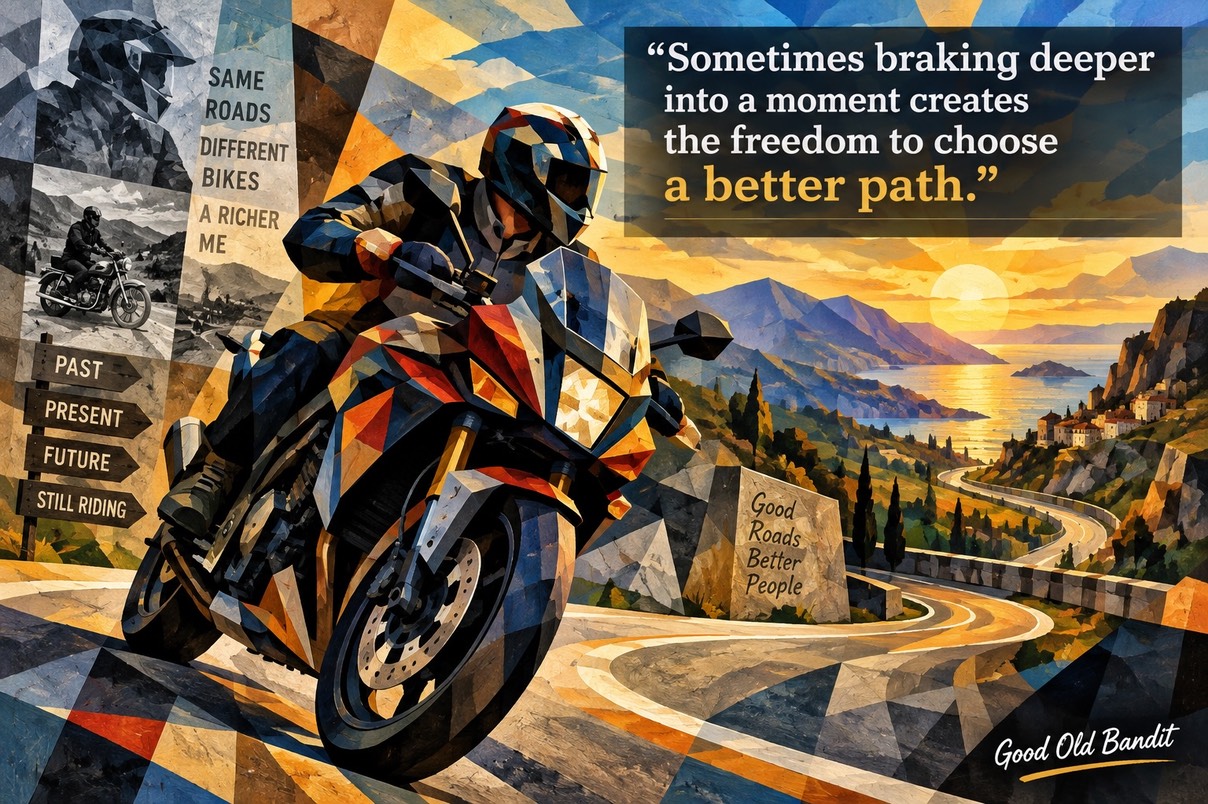
Sometimes braking deeper into a moment creates the freedom to choose a better path.
That lesson reaches beyond motorcycles, although motorcycles taught it beautifully.
I hope young riders enter this world.
I hope they respect the machine without fearing it.
I hope they chase competence before applause.
Most of all, I hope they experience that extraordinary moment when rider, motorcycle, road, and attention suddenly become one continuous movement.
You do not need forty years to feel it.
Sometimes one good corner is enough.
Carry Something into the Next Corner
Motorcycling has never been only about reaching somewhere.
The road teaches patience, awareness, humility, courage, and restraint.
Trail braking carries those qualities inside one small movement of the fingers.
You approach uncertainty while keeping control available.
You commit progressively rather than blindly.
You respect grip instead of demanding obedience from it.
And when the road finally opens, you release the brake and move forward.
After all these years, that still feels like freedom to me.
The motorcycle keeps giving back when we keep paying attention.
Ride long enough, and every corner leaves something behind.
Ride thoughtfully, and you carry something valuable into the next one.